Challah Bread
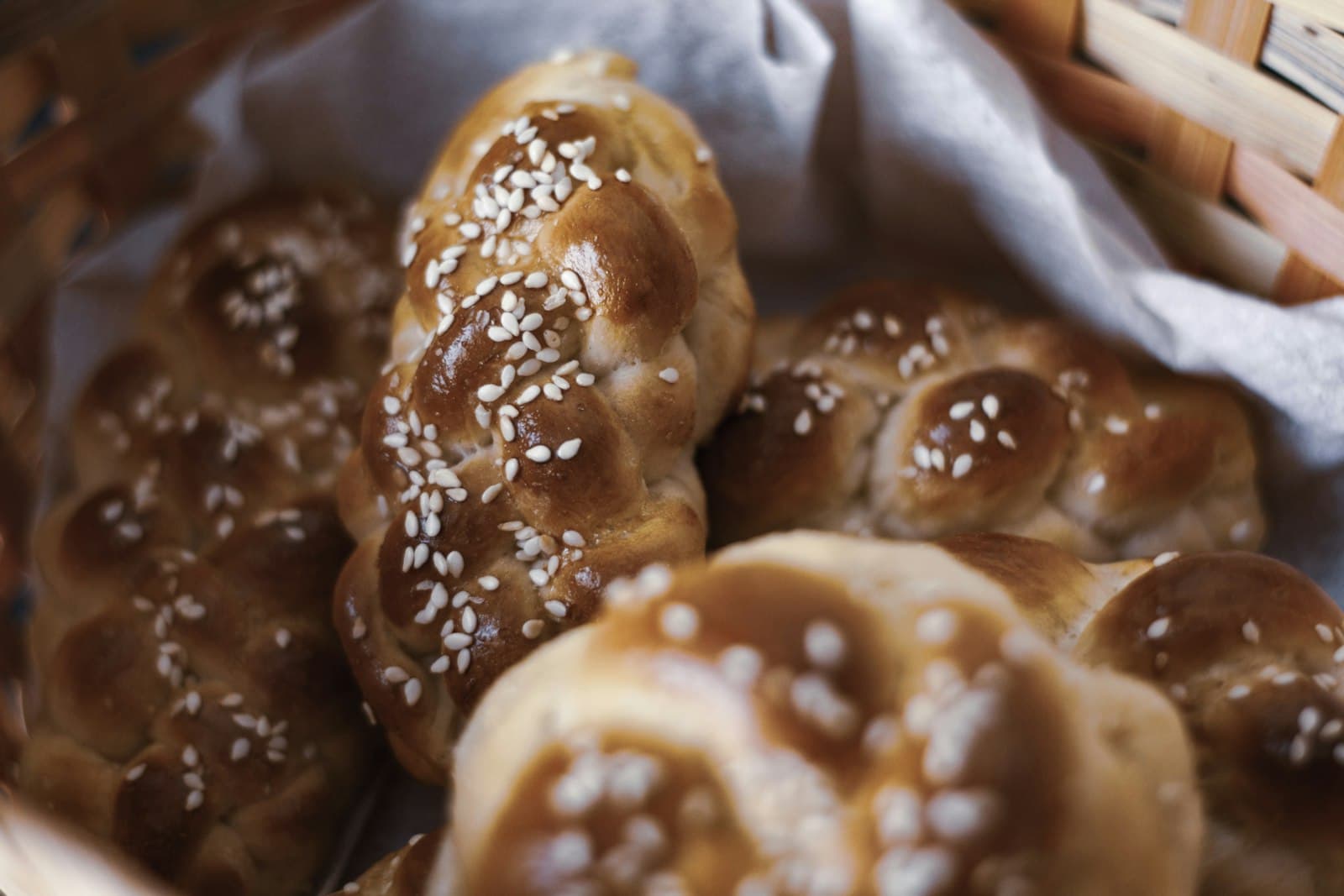
Challah is the braided egg bread served on Shabbat each week and at many Jewish holiday meals, Hanukkah included. This version uses oil instead of butter, so it contains no dairy and goes with any meal, brisket included. Two coats of egg wash give it a deep, shiny crust, and a simple three-strand braid is all you need for a handsome loaf.
Published
- Prep Time
- 30 mins
- Cook Time
- 35 mins
- Rise
- 2 hrs 30 mins
- Total Time
- 3 hrs 35 mins
- Servings
- 1 large loaf (12 slices)
How do you make Challah Bread?
To make challah, knead a dough of flour, yeast, sugar, salt, warm water, oil and 2 eggs for about 10 minutes and let it rise for 1 1/2 hours, until doubled. Roll it into three ropes, braid them and let the loaf rise for 45-60 minutes. Brush with egg wash and bake at 180°C (350°F) for 30-35 minutes, until deep golden.
- Total time
- 3 hrs 35 mins
- Calories
- 240 per serving
- Protein
- 6 g
- Yield
- 1 large loaf (12 slices)
- Difficulty
- Medium
- Method
- Baking
Ingredients
Dough
Egg wash
Equipment
Stand mixer with dough hook (optional) · Large baking sheet · Parchment paper · Pastry brush · Instant-read thermometer (optional)
Quick Directions
Mix the dough
Stir the warm water, yeast and 1 tsp of the sugar together in a stand mixer bowl or large bowl.
Knead
Knead with the dough hook on medium-low speed for 6-8 minutes, or by hand on a lightly floured surface for about 10 minutes, until smooth, elastic and barely tacky.
First rise
Put the dough in a lightly oiled bowl, turn it to coat, cover and leave in a warm place for about 1 1/2 hours, until doubled in size.
Shape the ropes
Press the air out of the dough and divide it into 3 equal pieces; a kitchen scale helps.
Braid
Lay the ropes side by side on a parchment-lined baking sheet and pinch them together at the top.
Second rise
Brush the loaf with egg wash, cover it loosely and leave for 45-60 minutes, until puffy and about 1 1/2 times its original size.
Bake
Brush with egg wash again, getting into the gaps in the braid, and sprinkle with seeds if using.
Step-by-Step Instructions
Follow these detailed steps to make the perfect challah bread.
Mix the dough
Stir the warm water, yeast and 1 tsp of the sugar together in a stand mixer bowl or large bowl. Add the rest of the sugar, the oil and the 2 eggs and whisk to combine. Add the flour and salt and mix into a shaggy dough.
Knead
Knead with the dough hook on medium-low speed for 6-8 minutes, or by hand on a lightly floured surface for about 10 minutes, until smooth, elastic and barely tacky. Add more flour a spoonful at a time only if the dough is very sticky.
First rise
Put the dough in a lightly oiled bowl, turn it to coat, cover and leave in a warm place for about 1 1/2 hours, until doubled in size.
Shape the ropes
Press the air out of the dough and divide it into 3 equal pieces; a kitchen scale helps. Roll each piece into a rope about 40 cm (16 inches) long, a little thicker in the middle than at the ends. If the dough keeps springing back, cover it and let it relax for 5 minutes.
Braid
Lay the ropes side by side on a parchment-lined baking sheet and pinch them together at the top. Cross the right rope over the middle one, then the left rope over the new middle one, and repeat to the end. Pinch the ends together and tuck both ends under the loaf.
Second rise
Brush the loaf with egg wash, cover it loosely and leave for 45-60 minutes, until puffy and about 1 1/2 times its original size. Heat the oven to 180°C (350°F) for the last 20 minutes.
Bake
Brush with egg wash again, getting into the gaps in the braid, and sprinkle with seeds if using. Bake for 30-35 minutes, until deep golden brown and the loaf sounds hollow when tapped underneath, or reads 88-90°C (190-195°F) in the centre. Cover loosely with foil after 20 minutes if it browns too quickly. Cool on a rack for at least 30 minutes before slicing.
Recipe Tips
- Brush with egg wash twice, once before the second rise and again just before baking, for the deepest colour and shine.
- Rolling the ropes thicker in the middle and thinner at the ends gives a neatly tapered braid.
- Day-old challah makes excellent French toast and bread pudding.
Variations
- Two smaller loaves: divide the dough in half, braid each half from three thinner ropes and bake for 22-25 minutes.
- Round challah: roll the dough into one long rope and coil it into a spiral, tucking the end underneath. Round loaves are traditional for Rosh Hashanah.
- Use 3 tbsp honey instead of the sugar for a gentle honey flavour.
- Knead 100 g (2/3 cup) raisins into the dough at the end of kneading.
Nutrition (per serving)
| Calories | 240 |
|---|---|
| Protein | 6 g |
| Carbs | 35 g |
| Fat | 8 g |
| Saturated fat | 1 g |
| Fibre | 1 g |
| Sugar | 4 g |
| Sodium | 290 mg |
Estimated from the listed ingredients; values vary by brand.
Related Recipes
Storing & Reheating
- Fridge
- Keep challah wrapped at room temperature for up to 3 days; the fridge dries bread out faster.
- Freezer
- Wrap the cooled loaf, or slices, tightly and freeze for up to 3 months. Thaw at room temperature.
- Reheat
- Warm a thawed loaf, wrapped in foil, at 160°C (325°F) for 10-15 minutes.
Challah Bread FAQs
What is challah?
Challah is a soft, slightly sweet braided bread made with eggs and oil. It is served on Shabbat and on Jewish holidays, often as two loaves on the table.
Is challah dairy-free?
This recipe is, because it uses oil instead of butter and water instead of milk. Challah is usually made without dairy so that it can be served with meat meals.
How do I know when challah is done?
It should be deep golden brown all over and sound hollow when tapped on the base. For certainty, check the centre with an instant-read thermometer: it should read 88-90°C (190-195°F).
Can I make challah dough ahead?
Yes. After kneading, cover the dough and refrigerate it overnight for a slow first rise. Shape it straight from the fridge and allow 1-1 1/2 hours for the second rise, since the cold dough takes longer to puff.
Disclaimer
- Nutrition information is an estimate based on the listed ingredients. It changes with the brands, portion sizes and swaps you use.
- Read ingredient labels for allergens and for diet claims such as gluten-free or vegan. Products and their ingredients can change.
- Cooking times are a guide, since ovens, air fryers and slow cookers all run differently. Use a food thermometer and cook meat, poultry and fish to the safe internal temperatures in government food safety guidance.
- This recipe is general information, not medical or nutrition advice. If you have an allergy, a health condition or a special diet, check with a qualified health professional.