Avgolemono Soup (Greek Lemon Chicken Soup)
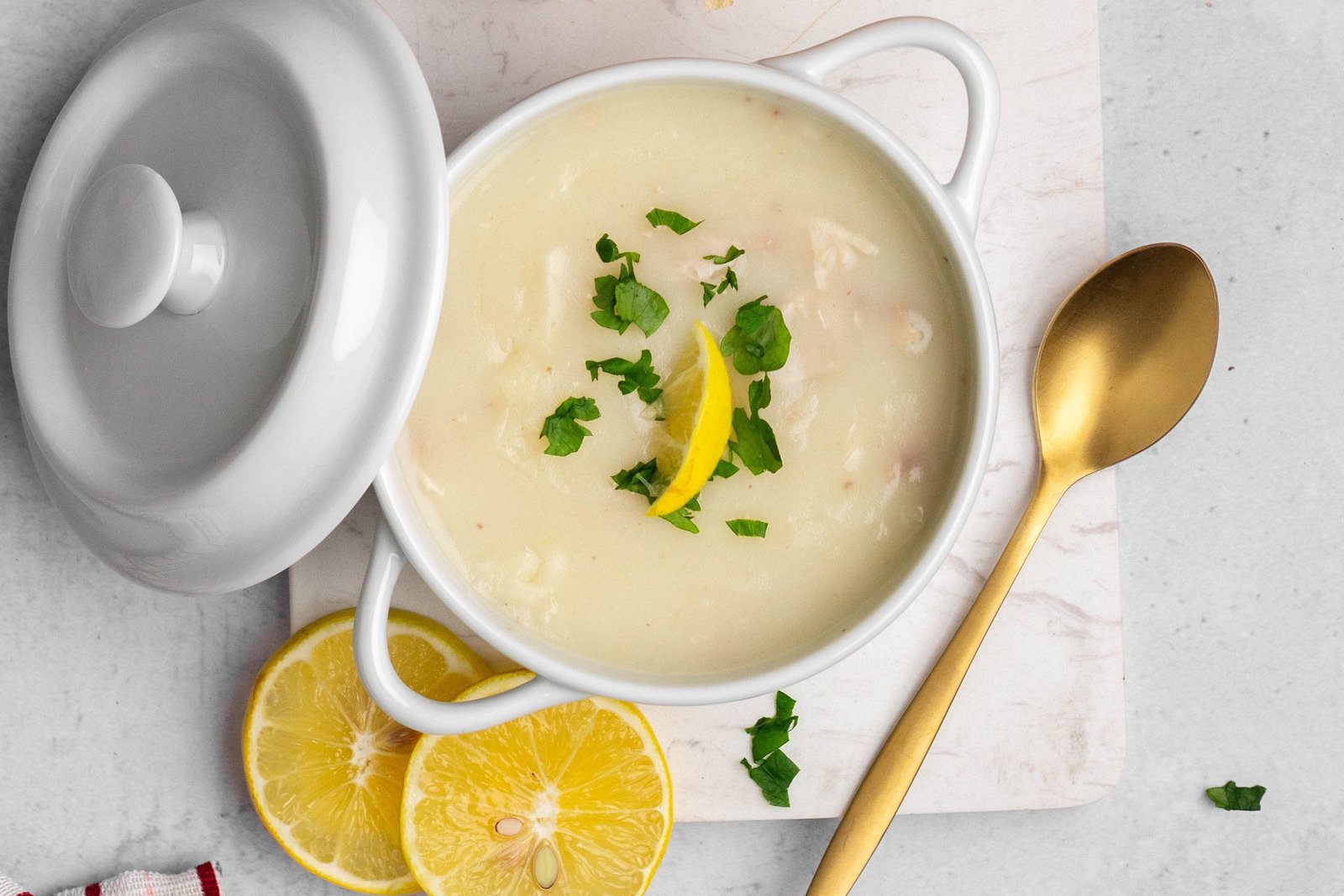
Avgolemono is the Greek name for a mixture of eggs and lemon juice, and for the soup it thickens: a chicken and rice broth that turns pale, opaque and silky once the egg goes in. Greek cooks also spoon the same egg-lemon over stuffed vine leaves and meatballs, but the soup is the version most people know. In this avgolemono soup, boneless thighs and rice simmer together in good stock, so the whole pot is ready in about an hour, and the eggs are warmed slowly with ladles of hot broth before they go into the pot.
By Priya Raman
Published
- Prep Time
- 15 mins
- Cook Time
- 45 mins
- Total Time
- 1 hr
- Servings
- 6 servings
How do you make Avgolemono Soup (Greek Lemon Chicken Soup)?
For avgolemono soup, simmer 800 g boneless chicken thighs and 150 g long-grain rice in 2 litres of chicken stock for 18-20 minutes, until the chicken reaches 74°C (165°F) and the rice is tender. Shred the chicken. Whisk 3 eggs with 90 ml lemon juice, beat in 3 ladles of hot broth, then stir it back into the pot over low heat until silky and steaming, without boiling.
- Total time
- 1 hr
- Calories
- 335 per serving
- Protein
- 33 g
- Yield
- 6 servings
- Difficulty
- Medium
- Method
- Simmering and tempering
Ingredients
Soup
Egg-lemon
To serve
Equipment
Large heavy pot (5-6 litres) with a lid · Large heatproof bowl · Whisk · Ladle · Two forks · Instant-read thermometer
Step-by-Step Instructions
Every step for making avgolemono soup (greek lemon chicken soup), written out in full.
Soften the onion
Set the pot over medium heat with the olive oil. When the oil shimmers, add the onion and a pinch of the salt and let it soften for 5 minutes, stirring once or twice, until translucent but not coloured.
Simmer the chicken and rice
Pour in the stock, add the bay leaf and the rest of the salt, then turn the heat to high and bring it up to a boil. Add the whole chicken thighs and the rinsed rice, lower the heat until the stock barely bubbles and partly cover the pot. Simmer for 18-20 minutes, scraping the rice off the bottom now and then, until the thickest thigh reads 74°C (165°F) and the rice is tender.
Shred the chicken
Transfer the thighs to a board and tear them into spoon-size shreds with two forks. Fish out the bay leaf. Keep the soup over low heat, hot but just below a simmer, while you make the egg-lemon.
Whisk the egg-lemon
In a large heatproof bowl, whisk the eggs for 1-2 minutes, until frothy and a shade paler. Keep whisking as you pour in the lemon juice in a thin stream.
Temper with hot broth
Scoop a ladle of hot broth, about 250 ml, from the pot, leaving the rice behind where you can, and pour it into the eggs very slowly while whisking hard. Repeat with 2 more ladles, still whisking, until the bowl feels warm and the mixture is loose and foamy.
Thicken without boiling
Keep the heat on low. Pour the tempered egg-lemon into the pot while stirring, then add the shredded chicken and pepper. Stir gently and constantly for 3-5 minutes, until the soup turns opaque and silky, coats the back of a spoon, is steaming and reads at least 74°C (165°F). Do not let it bubble at any point, or the egg will curdle into threads.
Season and serve
Taste and adjust with salt, pepper and an extra squeeze of lemon if you like it sharper. Ladle into warm bowls, scatter with dill or parsley and put lemon wedges on the table. The soup thickens as it stands, so serve it right away.
Recipe Tips
- Take the eggs out of the fridge 30 minutes before you start. Room-temperature eggs warm more evenly when the broth goes in and are less likely to set in streaks.
- The first ladle carries the most risk. Pour it in a thin thread with the whisk moving the whole time; once the bowl is warm, the next two can go in a little faster.
- Lemons vary a lot in sharpness. Start with the 90 ml in the recipe, then add more at the end a tablespoon at a time, tasting after each.
- Long-grain white rice keeps the broth fairly light. Medium- or short-grain rice releases more starch and gives a thicker, creamier soup.
- With only onion and a bay leaf behind it, the stock carries most of the flavour, so use the best you can get. Hold back on extra salt until the egg-lemon is in and you can taste the finished soup.
Variations
- Orzo avgolemono: replace the rice with 150 g orzo and add it for the last 8-10 minutes of the chicken's simmer. Orzo is wheat pasta, so the soup is no longer gluten-free.
- Whipped-white method: separate the eggs, beat the whites to soft peaks, then beat in the yolks one at a time followed by the lemon juice. Temper and finish as written for a lighter, foamier soup.
- Cooked chicken: simmer the rice in the stock for 15-18 minutes, then add 450 g (about 3 cups) shredded cooked chicken and heat until it is hot through, 74°C (165°F), before you temper the eggs.
- Chicken breast: poach 800 g boneless, skinless breasts the same way. They usually reach 74°C (165°F) in 15-18 minutes, so check early and lift them out while the rice finishes.
- Brighter lemon: whisk the finely grated zest of 1 lemon into the eggs along with the juice.
Nutrition (per serving)
| Calories | 335 |
|---|---|
| Protein | 33 g |
| Carbs | 24 g |
| Fat | 11 g |
| Saturated fat | 3 g |
| Fibre | 1 g |
| Sugar | 2 g |
| Sodium | 900 mg |
Estimated from the listed ingredients; values vary by brand.
Related Recipes
Storing & Reheating
- Fridge
- Cool the soup quickly and refrigerate it within 1 hour if you can, and no later than 2 hours after cooking, in airtight containers for up to 3 days. The rice keeps soaking up the broth, so expect a much thicker soup the next day.
- Freezer
- Avgolemono does not freeze well: the egg-thickened broth tends to split and turn grainy when thawed, and the rice goes mushy. To get ahead, poach the chicken in the stock without the rice, then freeze the stock and shredded chicken together for up to 3 months. Thaw overnight in the fridge, bring to a boil, cook the rice in it for 15-18 minutes and finish with fresh egg-lemon.
- Reheat
- Reheat over medium-low heat, stirring often and thinning it with a little stock or water, until steaming and 74°C (165°F). Never let it come to a boil, which curdles the egg. In the microwave, use medium power in 1-minute bursts, stirring after each one, to the same 74°C (165°F).
Avgolemono Soup (Greek Lemon Chicken Soup) FAQs
What does avgolemono mean?
Avgolemono joins the Greek words for egg (avgo) and lemon (lemoni). Besides chicken and rice soup, the same mixture finishes stuffed cabbage leaves and fricassee, a lamb or pork stew cooked with lettuce or wild greens.
Why did my avgolemono curdle?
The eggs got too hot too fast, either because the first ladles of broth went in too quickly or because the soup boiled after the egg was added. Pour the first ladle in a thin stream while whisking hard, and keep the pot below a simmer from then on. If a few threads appear, take the pot off the heat right away and whisk; fully scrambled egg cannot be smoothed out again.
Can you make avgolemono with orzo instead of rice?
Yes. Orzo, called kritharaki in Greece, is also widely used in this soup and gives it a little more bite. Use the same 150 g and cook it for 8-10 minutes, but remember that orzo is made from wheat, so the soup will no longer be gluten-free.
Can you freeze avgolemono soup?
It is not a good soup for the freezer. Once thawed, the egg-thickened broth usually separates and turns grainy, and the rice breaks down. Freeze the stock and poached chicken without the rice or egg instead, for up to 3 months, then cook the rice in it and whisk in fresh egg-lemon on the day you serve it.
Do you whip the egg whites separately for avgolemono?
Some cooks do. Beating the whites to soft peaks before adding the yolks and lemon makes a frothier, lighter soup. Whisking whole eggs until foamy, as this recipe does, is quicker and gives a smoother, silkier result, and both versions are tempered the same way.
Disclaimer
- Nutrition information is an estimate based on the listed ingredients. It changes with the brands, portion sizes and swaps you use.
- Read ingredient labels for allergens and for diet claims such as gluten-free or vegan. Products and their ingredients can change.
- Cooking times are a guide, since ovens, air fryers and slow cookers all run differently. Use a food thermometer and cook meat, poultry and fish to the safe internal temperatures in government food safety guidance.
- This recipe is general information, not medical or nutrition advice. If you have an allergy, a health condition or a special diet, check with a qualified health professional.