Jamaican Escovitch Fish
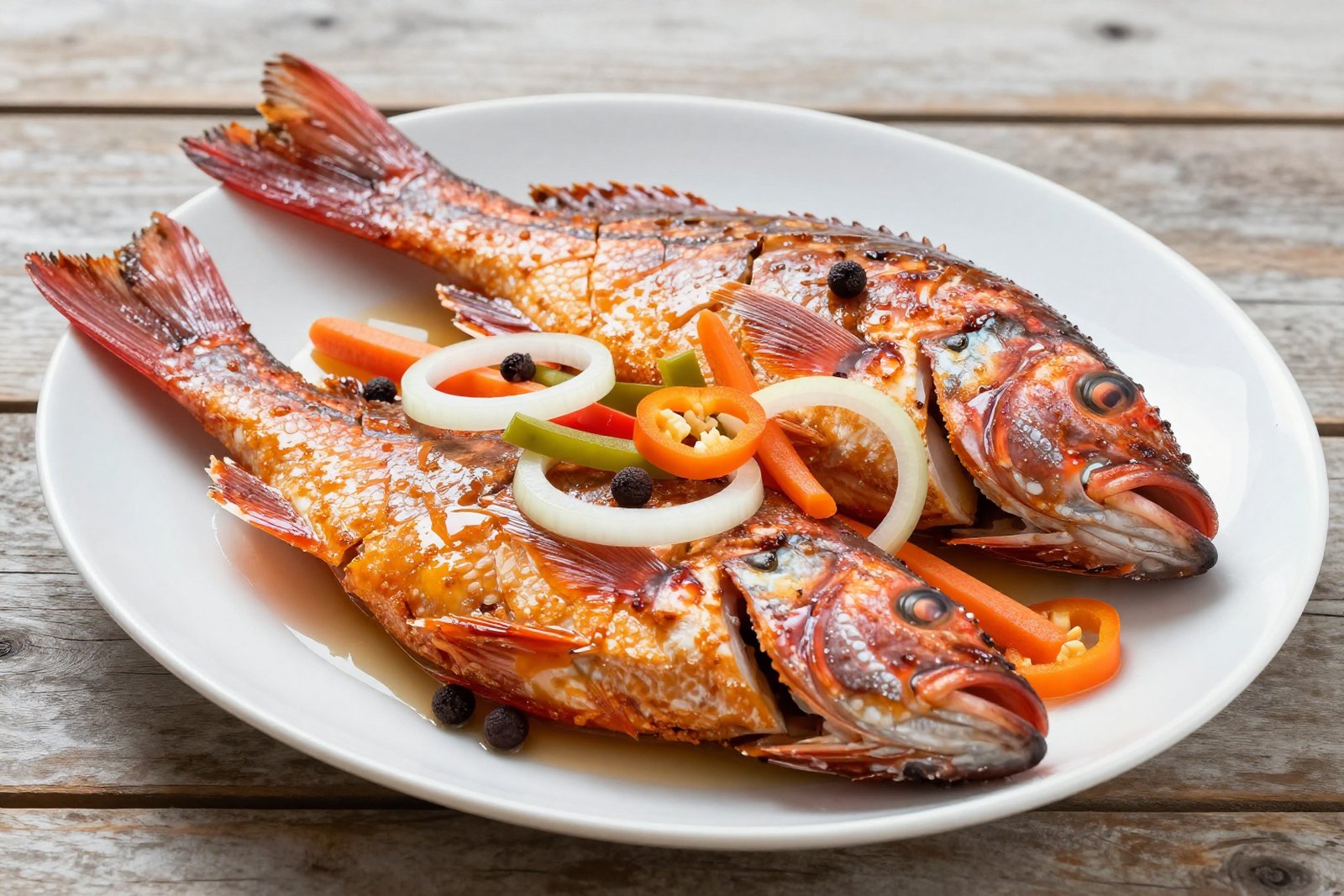
Escovitch fish is Jamaica's fried fish in pickle: whole fish seasoned simply, fried until the skin is crisp, then covered while still hot with onion, carrot, bell pepper and Scotch bonnet simmered briefly in vinegar with whole allspice berries. The name and the method are related to Spanish escabeche. In Jamaica it is a traditional Good Friday and Easter dish, since many households eat fish rather than meat then, and it is often cooked ahead because the flavour improves as the pickle soaks in. This version shallow-fries small whole snapper in 1 cm of oil in a skillet, with no flour, so the fish and its pickle are gluten-free.
By Mei Lin Tan
Published
- Prep Time
- 20 mins
- Cook Time
- 37 mins
- Soak
- 30 mins
- Total Time
- 1 hr 27 mins
- Servings
- 4 servings
How do you make Jamaican Escovitch Fish?
Score 4 small whole red snapper, season with salt, pepper and garlic powder and pat very dry. Shallow-fry in 1 cm of oil at 175°C (350°F) for 5-7 minutes per side, until crisp and 70°C (158°F) at the thickest part. Simmer onion, carrot, bell pepper, Scotch bonnet and allspice berries in vinegar for 2 minutes, pour over the fish and leave for 30 minutes.
- Total time
- 1 hr 27 mins
- Calories
- 310 per serving
- Protein
- 38 g
- Yield
- 4 servings
- Difficulty
- Medium
- Method
- Shallow frying
Ingredients
Fish
Escovitch pickle
To serve
Equipment
Large heavy skillet (30 cm / 12 inch) · Instant-read thermometer · Wire rack set over a baking sheet · Two wide spatulas · Tongs · Medium saucepan · Large shallow glass or ceramic dish · Disposable gloves
Step-by-Step Instructions
Every step for making jamaican escovitch fish, written out in full.
Score and season the fish
Pat the fish dry inside and out with paper towel. Cut 2 or 3 diagonal slashes into each side, down to the bone, so the thick part behind the head cooks at the same rate as the tail. Mix the 1 1/2 tsp salt with the black pepper and garlic powder and rub it over the skin, into the slashes and inside the cavity. Put the fish on a plate in the fridge while you cut the vegetables.
Cut the pickle vegetables
Slice the onion into thin rings, cut the carrot into matchsticks about 5 cm long and the bell pepper into thin strips. Wearing gloves, cut the stem off the Scotch bonnet, scrape out the seeds and slice the pepper into thin rings. Measure the vinegar, water, sugar, 1/2 tsp salt and allspice berries into a medium saucepan and leave it off the heat for now.
Heat the oil
Set a large, heavy skillet on the stove and add the oil. It should come 1 cm up the side, and the pan should be no more than half full; a straight-sided pan of the same width needs about 700 ml (scant 3 cups) to reach that depth. Heat it over medium-high heat to 175°C (350°F), which takes about 5 minutes. Oil this shallow will not cover the bulb of a clip-on thermometer, so dip the tip of an instant-read thermometer into it at an angle, keeping it off the metal. Set a wire rack over a baking sheet beside the stove, keep a lid within reach and do not leave the hot oil unattended.
Fry the fish
Take the fish out of the fridge and pat them very dry again: the salt draws moisture to the surface, and water makes hot oil spit. Lower 2 fish into the oil, head to tail, laying each one down away from you; the tail fins can rest against the side of the pan. If two will not lie flat side by side, fry them one at a time, which adds about 25 minutes. Fry for 5-7 minutes without moving them, until the underside is deep golden and lifts cleanly from the pan, then turn them carefully with two spatulas and fry for 5-7 minutes more. The skin should be crisp, the flesh opaque and flaking from the bone, and the thickest part, just behind the head, should read 70°C (158°F). If it reads lower, give the fish another minute on each side and check again. Adjust the heat to keep the oil close to 175°C (350°F). Drain the fish on the rack, let the oil come back to temperature and fry the other 2 fish the same way. Turn off the heat under the oil.
Simmer the pickle
Set the saucepan of vinegar, water, sugar, salt and allspice over medium-high heat and stir as it comes to a boil, so the sugar dissolves. This takes about 3 minutes. Add the onion, carrot, bell pepper and Scotch bonnet, bring back to a simmer and cook for 2 minutes, turning the vegetables through the liquid, which will not cover them. The onion should have just lost its raw bite and the carrot should still be crisp. Take the pan off the heat, and keep your face back from the vinegar steam.
Dress the fish
Arrange the fried fish in a large, shallow glass or ceramic dish, in a single layer or overlapping slightly. Lift the vegetables out of the saucepan with tongs and pile them over the fish, then pour the hot pickling liquid and the allspice berries over the top.
Soak and serve
Leave the fish to stand for at least 30 minutes, spooning the liquid in the dish back over it once or twice, so the pickle soaks into the slashes. Serve warm or at room temperature with festival, bammy or hard dough bread. Do not leave it out for more than 2 hours in total, counting the soaking time. If you are making it ahead, cover the dish and refrigerate it as soon as the 30 minutes are up, so that the time it spends on the table later still fits inside those 2 hours.
Recipe Tips
- Dry skin is what makes the fish crisp without flour. Water left on it turns to steam, glues the skin to the pan and makes the oil spit.
- Leave the fish alone for the first few minutes in the oil. The skin sticks at first and lets go once it has browned; turning too early tears it.
- Ask the fishmonger to scale and gut the fish and trim the fins. The heads are traditionally left on, but the recipe works the same without them.
- Most of a Scotch bonnet's heat is in the pale ribs and the seeds attached to them. Scrape them out for a pickle with moderate heat, or leave them in for a hot one.
- Once the frying oil is cold, strain it into a jar to reuse for fish, or seal it in a container and put it in the garbage. It should not go down the sink.
Variations
- Snapper fillets: use 4 thick, skin-on snapper fillets of about 170 g (6 oz) each and 1 tsp salt in place of the whole fish. Fry 2 at a time in the same 1 cm of oil at 175°C (350°F), skin side down first, for 3-4 minutes per side, until the flesh is opaque, flakes easily and reaches 70°C (158°F). Both batches take about 15 minutes.
- Kingfish steaks: slices of kingfish (king mackerel) about 2 cm thick are another common choice in Jamaica. Fry them for 3-4 minutes per side, to 70°C (158°F).
- With chayote: add half a chayote (cho cho), peeled and cut into thin strips, to the pickle with the carrot.
- Milder pickle: slice only half a Scotch bonnet, with its seeds and ribs scraped out, or simmer the pepper whole and uncut so it gives flavour with little heat, and lift it out before serving.
Nutrition (per serving)
| Calories | 310 |
|---|---|
| Protein | 38 g |
| Carbs | 10 g |
| Fat | 13 g |
| Saturated fat | 2 g |
| Fibre | 2 g |
| Sugar | 6 g |
| Sodium | 720 mg |
Estimated from the listed ingredients; values vary by brand.
Related Recipes
Storing & Reheating
- Fridge
- Cover the fish in its pickle and refrigerate it within 2 hours, in a glass or ceramic dish, for up to 3 days. The skin softens as it sits. Freezing is not recommended, because the pickled vegetables turn limp.
- Reheat
- Escovitch fish is usually eaten cold or at room temperature: serve it straight from the fridge, or take it out up to 30 minutes ahead, which counts toward its 2 hours out of the fridge. To serve it hot, cover the dish and warm it in a 160°C (325°F) oven for 20-25 minutes, until the fish reaches 74°C (165°F) at the thickest part.
Jamaican Escovitch Fish FAQs
What is escovitch fish?
Escovitch fish is a Jamaican dish of fried fish, most often whole red snapper, topped with a hot pickle made from vinegar, sliced onion, carrot, bell pepper, Scotch bonnet and whole allspice berries. The fish soaks in the pickle for at least 30 minutes and is served warm or at room temperature.
What kind of fish is best for escovitch?
Small whole red snapper of about 400 g (14 oz) each is the classic choice. Other firm fish work the same way, including sea bream, porgy and steaks of kingfish. Thick snapper fillets are the easiest option and fry in 3-4 minutes per side.
Why is escovitch fish eaten at Easter in Jamaica?
Many Jamaican households eat fish instead of meat on Good Friday, following Christian custom, and escovitch fish is one of the best-known choices. Because the dish is meant to sit in its vinegar pickle, it can be fried the day before and kept in the fridge, so the cooking is done ahead of the holiday.
Is escovitch fish served hot or cold?
Either. It is most often eaten at room temperature or cold, after the fried fish has soaked in the pickle for at least 30 minutes. It can stand at room temperature for up to 2 hours in total, soaking time included, and should go into the fridge before then, where it keeps for up to 3 days.
Do you flour fish before frying it for escovitch?
Some cooks dust the fish with flour, but it is not needed. This recipe fries the seasoned fish with no coating: as long as the skin is patted very dry and the oil is at 175°C (350°F), it turns crisp and lifts cleanly from the pan. Leaving out the flour also keeps the fish and its pickle gluten-free. Of the usual sides, bammy is made from cassava, while festival and hard dough bread are made with wheat flour.
Disclaimer
- Nutrition information is an estimate based on the listed ingredients. It changes with the brands, portion sizes and swaps you use.
- Read ingredient labels for allergens and for diet claims such as gluten-free or vegan. Products and their ingredients can change.
- Cooking times are a guide, since ovens, air fryers and slow cookers all run differently. Use a food thermometer and cook meat, poultry and fish to the safe internal temperatures in government food safety guidance.
- This recipe is general information, not medical or nutrition advice. If you have an allergy, a health condition or a special diet, check with a qualified health professional.