Bibimbap (Korean Mixed Rice Bowl)
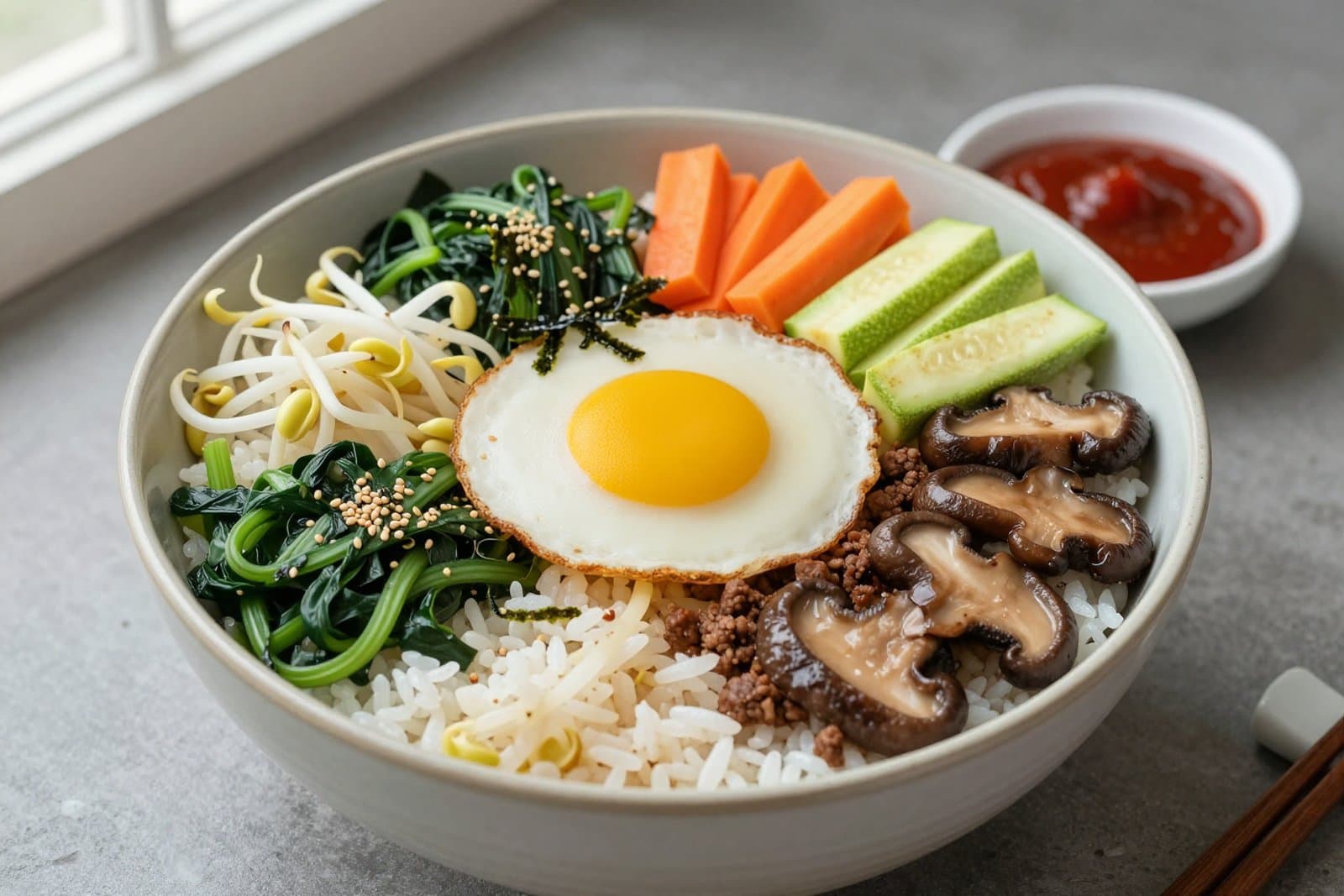
A bowl of bibimbap comes to the table neat: short-grain rice under small piles of lightly seasoned vegetables (namul), sweet soy ground beef and a fried egg. Then everyone stirs in as much gochujang sauce as they like and mixes the lot, which is where the name comes from: bibimbap means "mixed rice". Each vegetable gets a minute or two on its own, so the spinach stays deep green, the carrot bright orange and the sprouts crunchy. It sounds like a lot of parts, but the vegetables share one pot of boiling water and one skillet, and most of the work happens while the rice cooks.
By Mei Lin Tan
Published
- Prep Time
- 25 mins
- Cook Time
- 30 mins
- Total Time
- 55 mins
- Servings
- 4 servings
How do you make Bibimbap (Korean Mixed Rice Bowl)?
Cook 300 g short-grain rice. Blanch 300 g spinach for 30 seconds and 250 g bean sprouts for 2 minutes, then season each with sesame oil and salt. Stir-fry carrot, zucchini and shiitake one at a time, then brown 300 g ground beef with soy sauce, sugar and garlic to 71°C (160°F). Top the rice with everything and an egg fried until set, and stir in gochujang sauce.
- Total time
- 55 mins
- Calories
- 740 per serving
- Protein
- 34 g
- Yield
- 4 servings
- Difficulty
- Medium
- Method
- Sautéing
Ingredients
Rice
Gochujang sauce
Vegetables
Beef
Eggs and topping
Equipment
Medium saucepan with a tight-fitting lid · Fine-mesh sieve · Large pot · Large non-stick skillet with a lid · Tongs or a slotted spoon · Small bowls · Instant-read thermometer
Quick Directions
Cook the rice and mix the sauce
Simmer the rinsed rice for 13 minutes, rest it for 10 and mix the gochujang sauce.
Blanch the spinach and sprouts
Blanch the spinach for 30 seconds and the sprouts for 2 minutes, then season each.
Stir-fry the vegetables one at a time
Stir-fry the carrot, zucchini and shiitake one after another in the same skillet.
Cook the beef
Brown the beef, then glaze it with soy sauce, sugar and garlic until it reaches 71°C (160°F).
Fry the eggs
Fry the eggs, covered, until the whites and yolks are set.
Build the bowls
Top the rice with the vegetables, beef and egg and serve the sauce on the side.
Step-by-Step Instructions
Every step for making bibimbap (korean mixed rice bowl), written out in full.
Cook the rice and mix the sauce
Rinse the rice in a sieve under cold running water, swirling it with your hand, until the water runs almost clear, about 1 minute. Put it in the saucepan with the cold water and bring to the boil over high heat. Cover tightly, turn the heat to its lowest setting and cook for 13 minutes without lifting the lid, then turn off the heat and leave it covered to steam for 10 minutes. Meanwhile, bring a large pot of water to the boil, and stir the gochujang, 1 tbsp sugar, rice vinegar, 2 tsp sesame oil and water together in a small bowl until smooth.
Blanch the spinach and sprouts
Drop the spinach into the boiling water for 30 seconds, just until it wilts and turns deep green. Lift it out with tongs, rinse under cold water and squeeze it hard in your fists until no more water drips out. Cut the ball into 5 cm lengths, loosen it in a bowl and toss with the grated garlic, 1 tsp sesame oil and 1/4 tsp salt. Add the sprouts to the same water and boil for 2 minutes (5 minutes for soybean sprouts), until they lose their raw, beany smell but still snap. Drain, rinse in cold water, shake dry and toss with 1 tsp sesame oil and 1/4 tsp salt.
Stir-fry the vegetables one at a time
Heat 1 tsp vegetable oil in the skillet over medium-high heat. Stir-fry the carrot with a pinch of salt for 1-2 minutes, until it bends but is still bright orange, and tip it onto a plate. Add another 1 tsp oil and cook the zucchini with a pinch of salt for 2-3 minutes, until just tender. Add the last 1 tsp oil and cook the shiitake with 1 tsp soy sauce for 2-3 minutes, until soft and glossy. Keep each vegetable in its own pile.
Cook the beef
Stir the 2 tbsp soy sauce, 1 tbsp sugar and black pepper together in a small bowl. Put the beef in the same skillet over medium-high heat and break it up with a wooden spoon. Cook for 5-6 minutes, until browned with no pink left, then add the minced garlic and stir for 30 seconds. Pour in the soy mixture and cook for 1-2 minutes more, stirring, until the liquid is absorbed and the beef reaches 71°C (160°F). Stir in the 2 tsp sesame oil, move the beef to a bowl and wipe the skillet clean.
Fry the eggs
Heat 1 tbsp vegetable oil in the skillet over medium heat. Crack in the eggs, leaving a little space between them, and fry for 2 minutes, until the edges of the whites turn white and lacy. Turn the heat to medium-low, cover the pan and cook for 3-4 minutes more, until the whites and yolks are set. The lid traps steam, which cooks the tops of the yolks without burning the bottoms.
Build the bowls
Fluff the rice and divide it among 4 wide bowls. Arrange the spinach, sprouts, carrot, zucchini, shiitake and beef in separate piles over the rice, set an egg in the middle and sprinkle with sesame seeds and seaweed strips, if using. Put the gochujang sauce on the table so everyone can add a spoonful or two, then mix the whole bowl together before eating.
Recipe Tips
- Squeeze the spinach harder than seems necessary. Water left in it dilutes the seasoning and pools at the bottom of the bowl.
- Cook the vegetables in the order given. The shiitake and its soy sauce go last because they stain the pan, so the skillet only needs wiping once, after the beef.
- Gochujang heat varies from tub to tub. Serving the sauce at the table lets children have a mild bowl with a little sauce or none.
- If you like the yolk to coat the rice like a sauce, fry the eggs for less time. Runny yolks are not recommended for young children, pregnant people, older adults or anyone with a weakened immune system, so use pasteurized eggs if you serve them soft.
Variations
- Crispy rice crust (dolsot style): heat 1 tsp sesame oil in a small cast-iron skillet over medium heat, press in one portion of rice, add the toppings and a fried egg (cooked until set, as in step 5), and cook for 6-8 minutes, until the rice crackles and turns golden underneath. A Korean stone bowl works too: heat it gradually over gas or an electric coil (not induction) and allow a few minutes longer. Either one stays very hot, so set it on a board, not straight on the table.
- Tofu bibimbap: replace the beef with 400 g firm tofu, patted dry and cut into 1.5 cm cubes. Pan-fry it in 1 tbsp vegetable oil for 6-8 minutes, until golden, then toss with the beef seasonings (soy sauce, sugar, pepper, garlic and sesame oil) for 1 minute.
- Swap in other vegetables: salted cucumber matchsticks, sautéed bell pepper or a spoonful of kimchi all work. Keep each one in its own pile.
Nutrition (per serving)
| Calories | 740 |
|---|---|
| Protein | 34 g |
| Carbs | 87 g |
| Fat | 29 g |
| Saturated fat | 6 g |
| Fibre | 6 g |
| Sugar | 15 g |
| Sodium | 1340 mg |
Estimated from the listed ingredients; values vary by brand.
Related Recipes
Storing & Reheating
- Fridge
- Cool quickly (spread the rice in a shallow container) and refrigerate within 1 hour if you can, and no later than 2 hours after cooking. Keep the rice, beef and vegetables in separate airtight containers: the beef for up to 4 days, the vegetables and rice for up to 3 days. The gochujang sauce keeps for 1 week. Fry the eggs fresh when you serve.
- Reheat
- Reheat the rice and beef once only, covered with a sprinkle of water, until steaming and 74°C (165°F) throughout. The vegetables can go on cold from the fridge or be warmed with the rice.
Bibimbap (Korean Mixed Rice Bowl) FAQs
What does bibimbap mean?
Bibim means mixed and bap means cooked rice, so bibimbap is mixed rice. It comes to the table with each topping in its own pile over the rice, and you stir everything together with gochujang sauce before eating, so each mouthful has rice, vegetables, beef and egg.
What is dolsot bibimbap?
Dolsot bibimbap is served in a heavy stone bowl heated with a little sesame oil, so the rice against the sides turns golden and crackly. A small cast-iron skillet gives the same crust at home: heat 1 tsp sesame oil, press in a portion of rice with its toppings and cook over medium heat for 6-8 minutes.
What can I use instead of gochujang?
There is no exact substitute, because gochujang's fermented, sweet heat is the main flavour of the sauce. In a pinch, mix 2 tbsp white miso with 1-2 tbsp sriracha and 1 tsp sugar to replace the 3 tbsp in this recipe. Opened gochujang keeps for months in the fridge, so a tub is worth buying.
Can I make bibimbap ahead for meal prep?
Yes. Cool quickly (spread the rice in a shallow container) and refrigerate within 1 hour if you can, and no later than 2 hours after cooking, keeping each component in its own container. The beef keeps for up to 4 days, the vegetables and rice for up to 3 days. Reheat the rice and beef once, until steaming and 74°C (165°F), add the vegetables cold or warm, and fry a fresh egg for each bowl.
Disclaimer
- Nutrition information is an estimate based on the listed ingredients. It changes with the brands, portion sizes and swaps you use.
- Read ingredient labels for allergens and for diet claims such as gluten-free or vegan. Products and their ingredients can change.
- Cooking times are a guide, since ovens, air fryers and slow cookers all run differently. Use a food thermometer and cook meat, poultry and fish to the safe internal temperatures in government food safety guidance.
- This recipe is general information, not medical or nutrition advice. If you have an allergy, a health condition or a special diet, check with a qualified health professional.