Kimchi Fried Rice (Kimchi Bokkeumbap)
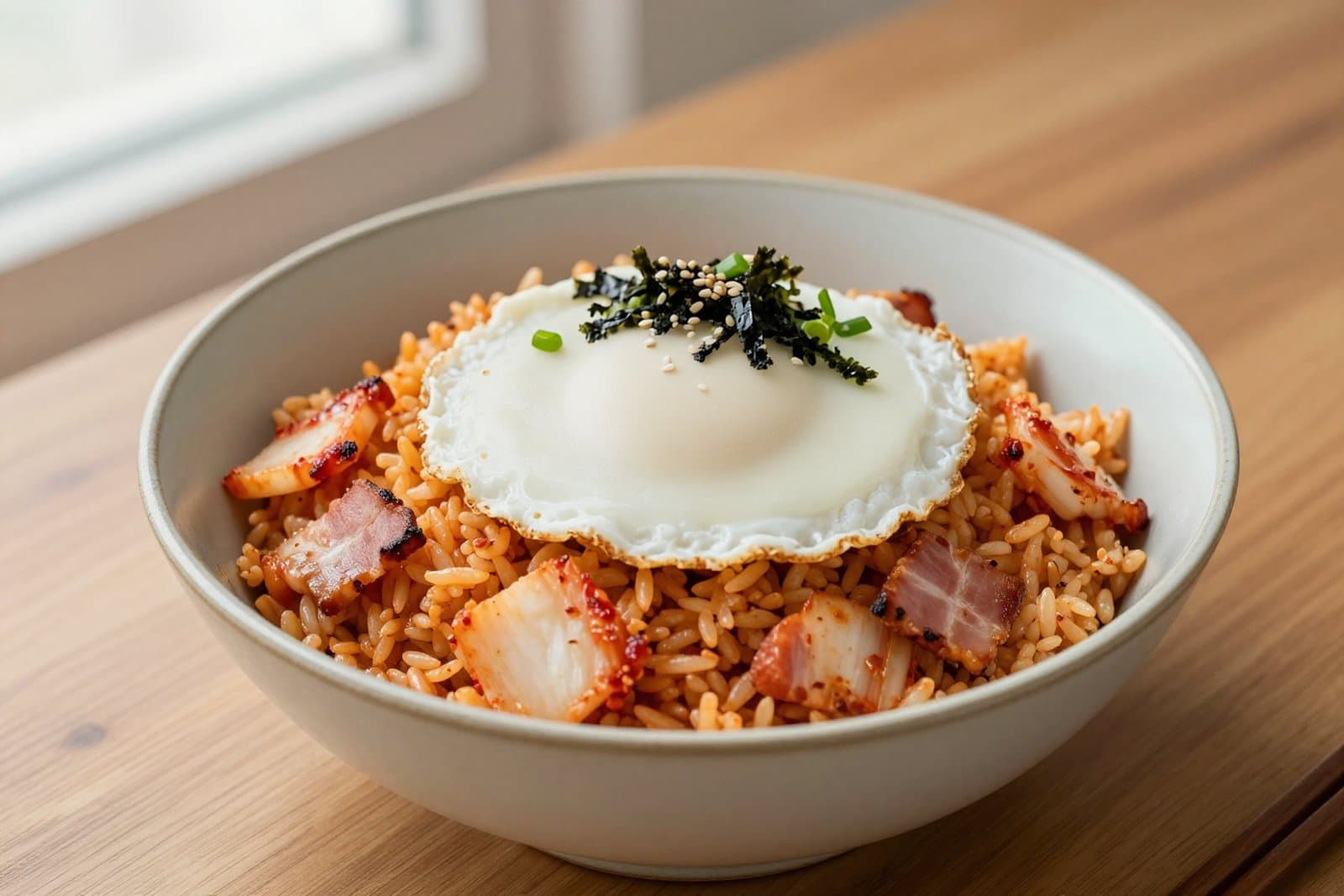
Kimchi bokkeumbap, stir-fried kimchi rice, is what Korean home cooks make when the kimchi has gone sour and there is cold rice in the fridge. Frying the kimchi in bacon fat takes the sharp edge off and turns it sweet and tangy, and a splash of its juice tints every grain orange-red. Cold rice matters here: it is drier than fresh, so the grains fry separately instead of turning mushy. Everything cooks in one skillet, including the fried eggs that go on top.
By Mei Lin Tan
Published
- Prep Time
- 10 mins
- Cook Time
- 25 mins
- Total Time
- 35 mins
- Servings
- 4 servings
How do you make Kimchi Fried Rice (Kimchi Bokkeumbap)?
Fry 150 g chopped bacon for 6-8 minutes until crisp, then stir-fry 300 g chopped sour kimchi with 1 tbsp gochujang and 1 tsp sugar for 4-5 minutes. Add 1 tbsp butter, 750 g cold cooked rice, 60 ml kimchi juice and 2 tsp soy sauce and toss for 5-6 minutes, until 74°C (165°F). Top with eggs fried until set, seaweed, sesame seeds and green onions.
- Total time
- 35 mins
- Calories
- 570 per serving
- Protein
- 18 g
- Yield
- 4 servings
- Difficulty
- Easy
- Method
- Stir-frying
Ingredients
Fried rice
Eggs and topping
Equipment
Large skillet or wok with a lid, at least 30 cm wide · Wide spatula · Kitchen scissors · Instant-read thermometer
Quick Directions
Prepare the ingredients
Chop the kimchi and bacon, slice the green onions and break up the rice.
Crisp the bacon
Cook the bacon for 6-8 minutes until crisp, leaving 2 tbsp fat in the pan.
Fry the kimchi
Stir-fry the kimchi with the gochujang and sugar for 4-5 minutes.
Fry the rice
Fry the rice with the butter, kimchi juice and soy sauce for 5-6 minutes, until 74°C (165°F).
Fry the eggs and serve
Fry the eggs, covered for 3-4 minutes, until the whites and yolks are set, and put one on each bowl.
Step-by-Step Instructions
Every step for making kimchi fried rice (kimchi bokkeumbap), written out in full.
Prepare the ingredients
Chop the kimchi on a board, or snip it in a bowl with kitchen scissors, and save the juice. Cut the bacon into 1 cm pieces and slice the green onions, keeping the white and green parts apart. Break up the cold rice with damp hands so no clumps are left, because a clump stays cold in the middle while the loose grains around it heat through. Cut the seaweed into thin strips.
Crisp the bacon
Put the bacon in the cold skillet, set it over medium heat and cook for 6-8 minutes, stirring now and then, until browned and crisp at the edges. Pork belly takes about the same time; cook it until browned with no pink left. Leave about 2 tbsp of fat in the pan and spoon off the rest. If there is less fat, add vegetable oil to make up 2 tbsp.
Fry the kimchi
Add the kimchi, the green onion whites, the gochujang, the gochugaru, if using, and the sugar. Stir-fry for 4-5 minutes, until the kimchi turns soft and slightly see-through, the edges catch a little and the pan smells sweet and tangy rather than sharp.
Fry the rice
Add the butter and let it melt, then add the rice, kimchi juice and soy sauce. Toss and press with the spatula for 5-6 minutes, until every grain is orange-red and the rice is steaming hot throughout and reaches 74°C (165°F). For the last minute, spread it flat and leave it alone so some grains crisp on the bottom. Taste, stir in the sesame oil and most of the green onion greens, and divide among 4 shallow bowls.
Fry the eggs and serve
Add the vegetable oil to the same skillet over medium heat and crack in the eggs. Cook for 2 minutes, until the whites turn opaque at the edges, then turn the heat to medium-low, cover and cook for 3-4 minutes more, until the whites and yolks are set. Slide an egg onto each bowl and finish with the seaweed strips, sesame seeds and the rest of the green onions.
Recipe Tips
- Only have fresh rice? Spread it on a large tray, let the steam escape for 10 minutes, then refrigerate it uncovered for 20-30 minutes. Quick cooling keeps it safe and dries the surface so the grains fry instead of steaming.
- If your kimchi is young and tastes more fresh than sour, add 1 tsp rice vinegar with the kimchi juice to get the tang that older kimchi brings.
- Gochujang varies in heat and in saltiness. Taste the rice before the sesame oil goes in, and add a little more soy sauce or kimchi juice only if it needs it.
- Kimchi fried rice is often served with a runny yolk to stir through the rice. Runny yolks are not recommended for young children, pregnant people, older adults or anyone with a weakened immune system, so use pasteurized eggs if you serve them soft.
Variations
- Luncheon meat: swap the bacon for 200 g canned pork luncheon meat cut into 1 cm cubes and browned in 1 tbsp vegetable oil for 4-5 minutes.
- Tuna: leave out the bacon, fry the kimchi in 2 tbsp vegetable oil and fold a drained 150 g can of tuna into the rice for the last 2 minutes.
- Cheese: scatter 100 g grated mozzarella over the rice in the pan, cover for 1-2 minutes until melted, then divide among the bowls and fry the eggs as written.
Nutrition (per serving)
| Calories | 570 |
|---|---|
| Protein | 18 g |
| Carbs | 61 g |
| Fat | 27 g |
| Saturated fat | 8 g |
| Fibre | 3 g |
| Sugar | 3 g |
| Sodium | 1160 mg |
Estimated from the listed ingredients; values vary by brand.
Related Recipes
Storing & Reheating
- Fridge
- Make only as much as you will eat. Cool any leftovers quickly in a shallow airtight container and refrigerate within 1 hour if you can, and no later than 2 hours after cooking. Keep them in the fridge for up to 1 day.
- Reheat
- Cooked rice should be reheated only once, and frying it counts, so eat leftovers cold rather than reheating them.
Kimchi Fried Rice (Kimchi Bokkeumbap) FAQs
What kind of kimchi is best for kimchi fried rice?
Well-fermented napa cabbage kimchi that tastes clearly sour, usually one that has been open in the fridge for a few weeks. Frying mellows the sourness and brings out a sweet, savoury depth. Fresh kimchi works too but tastes flatter, so add a splash more juice or 1 tsp rice vinegar.
Can I make kimchi fried rice with freshly cooked rice?
Yes, though cold rice fries better: its grains are drier and stay separate instead of clumping. Cool fresh rice quickly on a tray and chill it before frying, as in the tips. If you cook rice especially for this, use about 390 ml (1 2/3 cups) water for 300 g rice instead of the usual 420 ml (1 3/4 cups).
What can I use instead of bacon?
Thinly sliced pork belly, cooked until browned with no pink left, is the closest swap. Canned pork luncheon meat and drained canned tuna are both common in Korean homes. For a meatless version, fry the kimchi in 2 tbsp vegetable oil and check the label, since most kimchi contains fish sauce or salted shrimp.
How do I make kimchi fried rice less spicy?
Leave out the gochugaru and use a mild gochujang; many tubs carry a heat rating. The butter and the egg also soften the heat. If you have no gochujang, 1-2 tsp sriracha with 1 tsp sugar stands in for the 1 tbsp in this recipe.
Disclaimer
- Nutrition information is an estimate based on the listed ingredients. It changes with the brands, portion sizes and swaps you use.
- Read ingredient labels for allergens and for diet claims such as gluten-free or vegan. Products and their ingredients can change.
- Cooking times are a guide, since ovens, air fryers and slow cookers all run differently. Use a food thermometer and cook meat, poultry and fish to the safe internal temperatures in government food safety guidance.
- This recipe is general information, not medical or nutrition advice. If you have an allergy, a health condition or a special diet, check with a qualified health professional.