Oatmeal Raisin Cookies
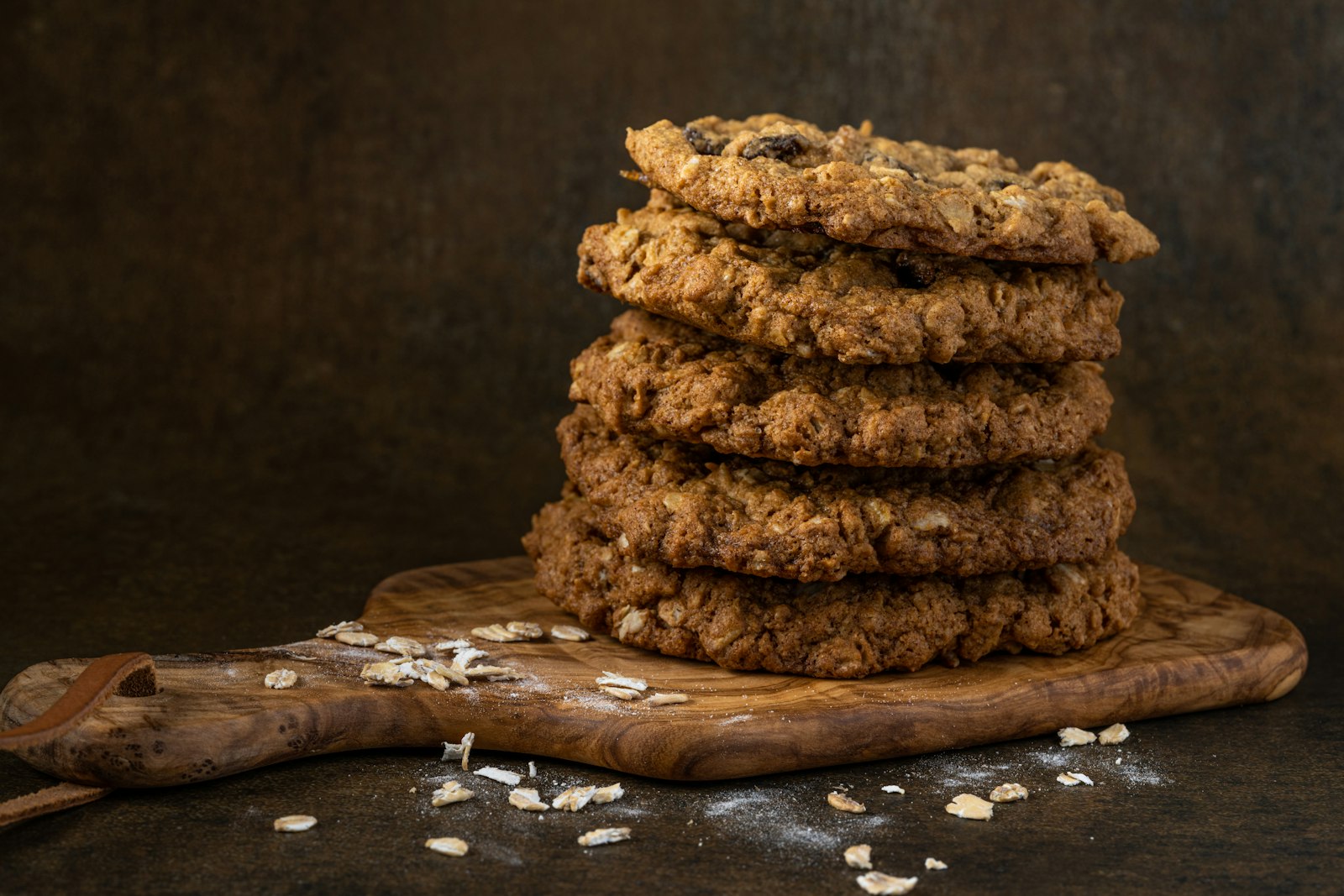
An oatmeal raisin cookie stays chewy when the dough holds on to its moisture, and three choices here do that job: four times as much brown sugar as white, large-flake rolled oats that keep their shape, and raisins soaked in hot water so they give moisture to the cookie instead of drawing it out. Half an hour in the fridge lets the oats take up some of the liquid, so the cookies bake thick, with crisp rims and soft cinnamon middles.
Published
- Prep Time
- 25 mins
- Cook Time
- 39 mins
- Chill and cool
- 40 mins
- Total Time
- 1 hr 44 mins
- Servings
- about 30 cookies
How do you make Oatmeal Raisin Cookies?
For chewy oatmeal raisin cookies, cream 225 g butter with 200 g brown sugar and 50 g granulated sugar, beat in 2 eggs, then mix in 210 g flour, 1 tsp baking soda, cinnamon, 270 g large-flake rolled oats and 150 g soaked raisins. Chill for 30 minutes and bake 40 g balls at 180°C (350°F) for 11-13 minutes, until the rims are golden and the middles still look soft.
- Total time
- 1 hr 44 mins
- Calories
- 165 per serving
- Protein
- 2.5 g
- Yield
- about 30 cookies
- Difficulty
- Easy
- Method
- Baking
Ingredients
Equipment
Stand mixer or hand mixer · Heatproof bowl · Sieve · Mixing bowl · 2 baking sheets · Parchment paper · Kitchen scale · Wire rack
Step-by-Step Instructions
Every step for making oatmeal raisin cookies, written out in full.
Soak the raisins
Put the raisins in a heatproof bowl, pour over enough just-boiled water to cover them and leave for 10 minutes. Tip them into a sieve, shake off the water and pat them dry with a clean tea towel. Wet raisins make the dough sticky.
Combine the dry ingredients
While the raisins soak, whisk the flour, baking soda, cinnamon and salt together in a bowl.
Cream the butter and sugars
Beat the butter with the brown sugar and granulated sugar on medium speed for about 2 minutes, until smooth and creamy. Stop before the mixture turns pale and fluffy: the extra air makes oatmeal cookies rise and bake up cakey. Add the eggs one at a time, beating after each, then beat in the vanilla.
Mix in the flour, oats and raisins
Add the flour mixture on low speed and stop while a few floury streaks are still showing. Tip in the oats and the drained raisins and mix on low, or fold with a spatula, until they are spread evenly through the dough.
Rest the dough in the fridge
Cover the bowl and chill for 30 minutes. The oats soak up some of the moisture and the butter firms, which is what keeps the cookies thick. Towards the end of the chill, line two baking sheets with parchment paper and switch the oven on at 180°C (350°F).
Portion the dough
Scoop the dough into 40 g mounds (about 2 1/2 tablespoons each) and roll them loosely into balls. Each baking sheet takes 10 balls with 5 cm (2 inches) between them; the dough that is left goes back in the fridge. Poke any raisins sitting on the outside back into the dough so they don't scorch.
Bake in three batches
Bake a single sheet at a time, on the middle oven rack, for 11-13 minutes, until the rims are set and golden brown and the middles are puffed, paler and still look a little underbaked. The 30 cookies take three batches of 10; let the first sheet cool completely before loading it with the third batch.
Cool on the sheet
Leave the cookies where they are for 10 minutes. They are too soft to lift straight from the oven and finish setting as they stand. Transfer them to a wire rack to cool completely.
Recipe Tips
- Buy large-flake rolled oats, sold as old-fashioned oats in some countries. Quick oats are cut finer and soak up more of the dough's moisture, so the cookies come out softer and closer to cake, and steel-cut oats stay hard.
- A cup of flour scooped straight from the bag can weigh 20-30 g more than a cup that was spooned and levelled, and that extra flour is the usual reason oatmeal cookies turn out dry and cakey. Use the scale if you have one.
- Go by the middles, not the clock. Cookies that look fully baked in the oven will be crisp right through once they cool; cookies with soft, pale middles cool to chewy.
- Never put dough on a warm baking sheet. The butter melts before the cookie has a chance to set, and the batch bakes thin with greasy edges.
Variations
- Oatmeal chocolate chip: swap the raisins for 170 g (1 cup) semi-sweet chocolate chips and skip the soaking step.
- Add 60 g (1/2 cup) chopped toasted walnuts or pecans along with the oats.
- Replace the raisins with the same 150 g of dried cranberries (about 1 1/4 cups) or chopped dates (about 1 cup) and add 1 tsp finely grated orange zest with the vanilla. Soak cranberries the same way; dates don't need it.
- For a spiced version, add 1/4 tsp ground nutmeg and 1/4 tsp ground ginger to the flour mixture.
- Make large cookies: shape 60 g balls, give each one 8 cm (3 inches) of room and allow 14-16 minutes in the oven. The batch makes about 20.
Nutrition (per serving)
| Calories | 165 |
|---|---|
| Protein | 2.5 g |
| Carbs | 24 g |
| Fat | 7 g |
| Saturated fat | 4 g |
| Fibre | 1.5 g |
| Sugar | 11.5 g |
| Sodium | 90 mg |
Estimated from the listed ingredients; values vary by brand.
Related Recipes

Storing & Reheating
- Fridge
- An airtight container on the counter holds the cooled cookies for up to 5 days. Skip the fridge, which dries them out.
- Freezer
- Shaped dough balls freeze well: firm them up on a tray, move them to a freezer bag and use within 3 months, baking from frozen at 180°C (350°F) with 1-2 minutes added. Cookies that are already baked can be frozen for the same 3 months and thaw on the counter in about 30 minutes.
- Reheat
- To soften a day-old cookie, give it 10 seconds in the microwave or 3-4 minutes in a 150°C (300°F) oven.
Oatmeal Raisin Cookies FAQs
Why are my oatmeal raisin cookies cakey instead of chewy?
Three things make oatmeal cookies cakey: excess flour, excess air and overbaking. Put the flour on a scale or spoon it lightly into the cup, cream the butter and sugar only until smooth rather than pale and fluffy, and take the cookies out while the middles still look soft. Using mostly brown sugar, as this recipe does, also keeps them moist and chewy.
Do I need to soak raisins before baking them in cookies?
Soft, freshly opened raisins can go straight into the dough. Raisins that have dried out in the cupboard should be soaked: cover them with just-boiled water for 10 minutes, drain them and pat them dry. Dry raisins pull moisture out of the cookie as it bakes and turn hard, while soaked ones stay plump.
Can I use quick oats instead of large-flake rolled oats?
Yes, weight for weight. Quick oats are rolled oats cut into smaller pieces, so the cookies hold together well but are softer, more uniform and less chewy, with less of the oat texture. Don't use instant oatmeal, which turns pasty, or steel-cut oats, which stay hard after 13 minutes in the oven.
Why did my oatmeal cookies spread out flat?
The butter was probably too warm. Start with butter that is soft enough to dent but not shiny or greasy, chill the dough for the full 30 minutes, keep the unbaked dough in the fridge between batches and never load a baking sheet that is still warm. Too little flour does the same thing, so measure it carefully.
Can I make oatmeal raisin cookie dough the day before?
Yes. Cover the bowl and keep the dough in the fridge for up to 2 days; let it stand at room temperature for 15 minutes if it is too stiff to scoop. For longer storage, freeze the shaped balls for up to 3 months and bake them from frozen at 180°C (350°F), adding 1-2 minutes.
Disclaimer
- Nutrition information is an estimate based on the listed ingredients. It changes with the brands, portion sizes and swaps you use.
- Read ingredient labels for allergens and for diet claims such as gluten-free or vegan. Products and their ingredients can change.
- Cooking times are a guide, since ovens, air fryers and slow cookers all run differently. Use a food thermometer and cook meat, poultry and fish to the safe internal temperatures in government food safety guidance.
- This recipe is general information, not medical or nutrition advice. If you have an allergy, a health condition or a special diet, check with a qualified health professional.