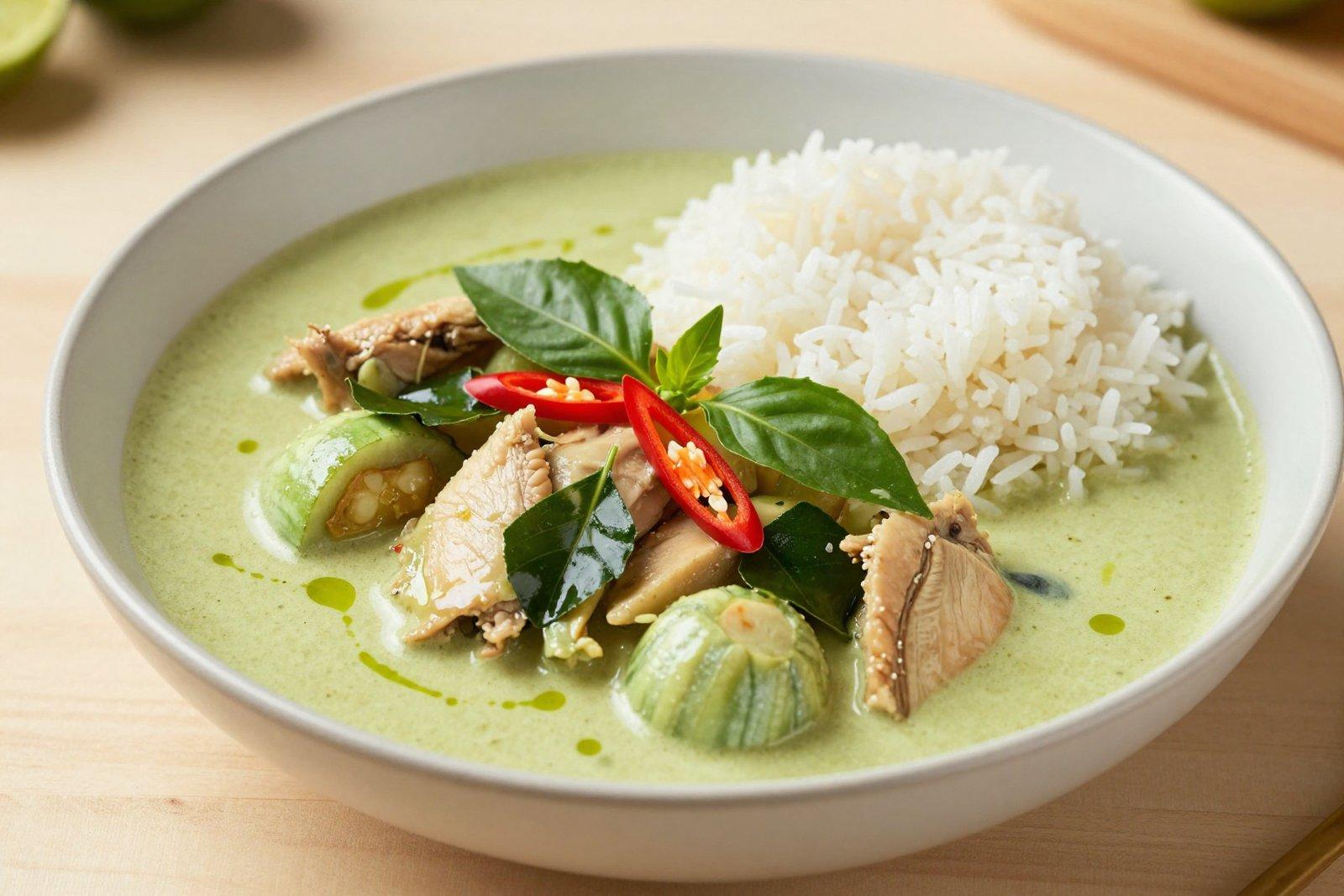
Thai Green Curry with Chicken
Thai green curry, gaeng khiao wan, gets its colour and heat from fresh green chillies blended with lemongrass, galangal, shallots, garlic, coriander and makrut lime. The paste is fried in thick coconut cream until fragrant, then chicken, eggplant and the rest of the coconut milk simmer for about 10 minutes, and a handful of Thai basil goes in at the end. The paste takes about 15 minutes to make in a blender; a store-bought green curry paste works when time is short, and brings the total time down to about 35 minutes.
By Mei Lin Tan
Published
- Prep Time
- 25 mins
- Cook Time
- 30 mins
- Total Time
- 55 mins
- Servings
- 4 servings
How do you make Thai Green Curry with Chicken?
Blend green chillies, lemongrass, galangal, shallots, garlic, coriander, lime zest, shrimp paste and toasted spices into a paste. Fry it for 3-4 minutes in 125 ml coconut cream cooked until the oil separates, then add 500 g sliced chicken thighs, the rest of the coconut milk, water, fish sauce, palm sugar and eggplant. Simmer for 8-10 minutes until the chicken reaches 74°C (165°F), then stir in Thai basil.
- Total time
- 55 mins
- Calories
- 470 per serving
- Protein
- 29 g
- Yield
- 4 servings
- Difficulty
- Medium
- Method
- Simmering
Ingredients
Green curry paste
Curry
To finish
Equipment
Small dry skillet · Spice grinder or mortar and pestle · Small blender or food processor · Wok or wide, heavy pot
Quick Directions
Toast the spices
Toast and grind the coriander seeds, cumin seeds and white peppercorns.
Blend the paste
Blend the paste ingredients with a little water until smooth.
Cook the coconut cream
Simmer the thick coconut cream for 5-7 minutes until the oil separates.
Fry the paste
Fry the curry paste for 3-4 minutes until fragrant.
Add the chicken
Stir the chicken into the paste and cook for 2 minutes.
Simmer the curry
Add the coconut milk, water, seasonings and eggplant and simmer for 8-10 minutes until the chicken is cooked through.
Finish and serve
Season to taste, stir in the basil and red chilli and serve with rice.
Step-by-Step Instructions
Every step for making thai green curry with chicken, written out in full.
Toast the spices
Toast the coriander seeds, cumin seeds and white peppercorns in a small dry skillet over medium heat for 1-2 minutes, shaking the pan, until fragrant and a shade darker. Let them cool for a minute, then grind finely.
Blend the paste
Put the chillies, lemongrass, galangal, shallots, garlic, coriander roots, lime zest, shrimp paste, salt, ground spices and oil in a small blender or food processor with 2-3 tbsp water. Blend for 3-5 minutes, scraping down the sides often, until as smooth as you can get it. It makes about 125 ml (1/2 cup). A mortar and pestle gives a finer, more aromatic paste but takes about 20 minutes.
Cook the coconut cream
Open the can of coconut milk without shaking it and spoon the thick cream from the top, about 125 ml (1/2 cup), into a wok or wide pot. Simmer it over medium heat for 5-7 minutes, stirring often, until it thickens and the oil separates and shimmers on the surface. If your coconut milk does not separate, add the optional 1 tbsp oil and carry on.
Fry the paste
Add all the curry paste and fry it in the coconut cream for 3-4 minutes, stirring constantly, until it smells fragrant, darkens slightly and the oil turns green.
Add the chicken
Add the chicken and stir to coat it in the paste. Cook for 2 minutes, until the outside of the slices turns opaque.
Simmer the curry
Pour in the rest of the coconut milk and the water, then add the lime leaves, fish sauce, palm sugar and eggplant. Bring to a gentle simmer and cook uncovered for 8-10 minutes, stirring now and then, until the eggplant is tender and the chicken is cooked through, with no pink when you cut the thickest slice. Chicken pieces should reach 74°C (165°F). Keep it at a simmer rather than a hard boil, which can make the coconut milk split.
Finish and serve
Taste the curry: it should be spicy, savoury and slightly sweet. Add a little more fish sauce for salt or palm sugar to balance the heat. Turn off the heat, stir in the Thai basil and sliced red chilli, and serve with jasmine rice.
Recipe Tips
- Use full-fat coconut milk. Light coconut milk won't separate and makes a thin curry.
- Green chillies vary a lot in heat. Taste a tiny bit of the paste before frying it, and for a milder curry use only part of the paste and freeze the rest.
- Store-bought paste: use 3-4 tbsp (45-60 g) and start with less, because brands vary in heat and salt. Taste before adding the fish sauce.
- Thai eggplants are small, round and green and white. Cut them just before cooking, because they brown quickly once cut. Asian eggplant or zucchini work in their place.
- Galangal, lemongrass and makrut lime leaves freeze well, and Asian grocers often sell them frozen.
Variations
- Chicken breast: slice it thinly and simmer for only 5-6 minutes, until no pink remains and it reaches 74°C (165°F).
- Add 1 cup drained canned bamboo shoots with the eggplant, or use green beans in place of the eggplant.
- Shrimp: use 500 g peeled raw shrimp instead of chicken, adding them after the eggplant has simmered for 5 minutes, and cook for 3-4 minutes until pink and opaque.
- Vegetarian: use 400 g pressed, cubed extra-firm tofu instead of chicken, replace the shrimp paste with 1 tsp white miso and season with soy sauce or a vegetarian fish sauce.
Nutrition (per serving)
| Calories | 470 |
|---|---|
| Protein | 29 g |
| Carbs | 18 g |
| Fat | 32 g |
| Saturated fat | 21 g |
| Fibre | 3.5 g |
| Sugar | 6.5 g |
| Sodium | 980 mg |
Estimated from the listed ingredients; values vary by brand.
Related Recipes
Storing & Reheating
- Fridge
- Refrigerate within 2 hours in an airtight container for up to 3 days; the basil darkens, but the flavour holds. Keep leftover curry paste covered in the fridge for up to 1 week.
- Freezer
- Freeze the curry paste in an ice cube tray, then in a freezer bag, for up to 3 months. The finished curry is best eaten fresh, because frozen eggplant turns soft and the coconut sauce can separate.
- Reheat
- Reheat gently in a pan over medium-low heat, stirring, until steaming hot, 74°C (165°F). Don't boil it hard, or the coconut milk may split.
Thai Green Curry with Chicken FAQs
What does gaeng khiao wan mean?
Gaeng (also spelled kaeng) means curry, khiao means green and wan means sweet, so the name translates as sweet green curry. It is often explained as describing the soft green colour of the coconut sauce rather than a sugary taste; the curry itself is spicy and savoury with only a little sweetness.
Is Thai green curry spicier than red curry?
Often, yes. Green curry paste is made with fresh green chillies, which tend to be hotter than the dried red chillies in red curry paste. The heat depends on the chillies you use, so taste the paste and use less of it for a milder curry.
Can I use store-bought green curry paste?
Yes. Use 3-4 tbsp (45-60 g) in place of the homemade paste and fry it in the coconut cream the same way. Brands vary in heat and saltiness, so start with less and taste before you add the fish sauce.
Is Thai green curry vegetarian or gluten-free?
Not vegetarian: the paste contains shrimp paste and the curry is seasoned with fish sauce. It is gluten-free as written, but some fish sauces, shrimp pastes, stocks and store-bought curry pastes contain wheat, so check the labels if you need to avoid gluten.
What can I use instead of galangal, makrut lime and Thai basil?
Use the same amount of fresh ginger for galangal, the zest of a regular lime for makrut lime zest or leaves, and Italian basil for Thai basil. The curry will taste less floral and less like aniseed, but the method stays the same.
Disclaimer
- Nutrition information is an estimate based on the listed ingredients. It changes with the brands, portion sizes and swaps you use.
- Read ingredient labels for allergens and for diet claims such as gluten-free or vegan. Products and their ingredients can change.
- Cooking times are a guide, since ovens, air fryers and slow cookers all run differently. Use a food thermometer and cook meat, poultry and fish to the safe internal temperatures in government food safety guidance.
- This recipe is general information, not medical or nutrition advice. If you have an allergy, a health condition or a special diet, check with a qualified health professional.