Thumbprint Cookies
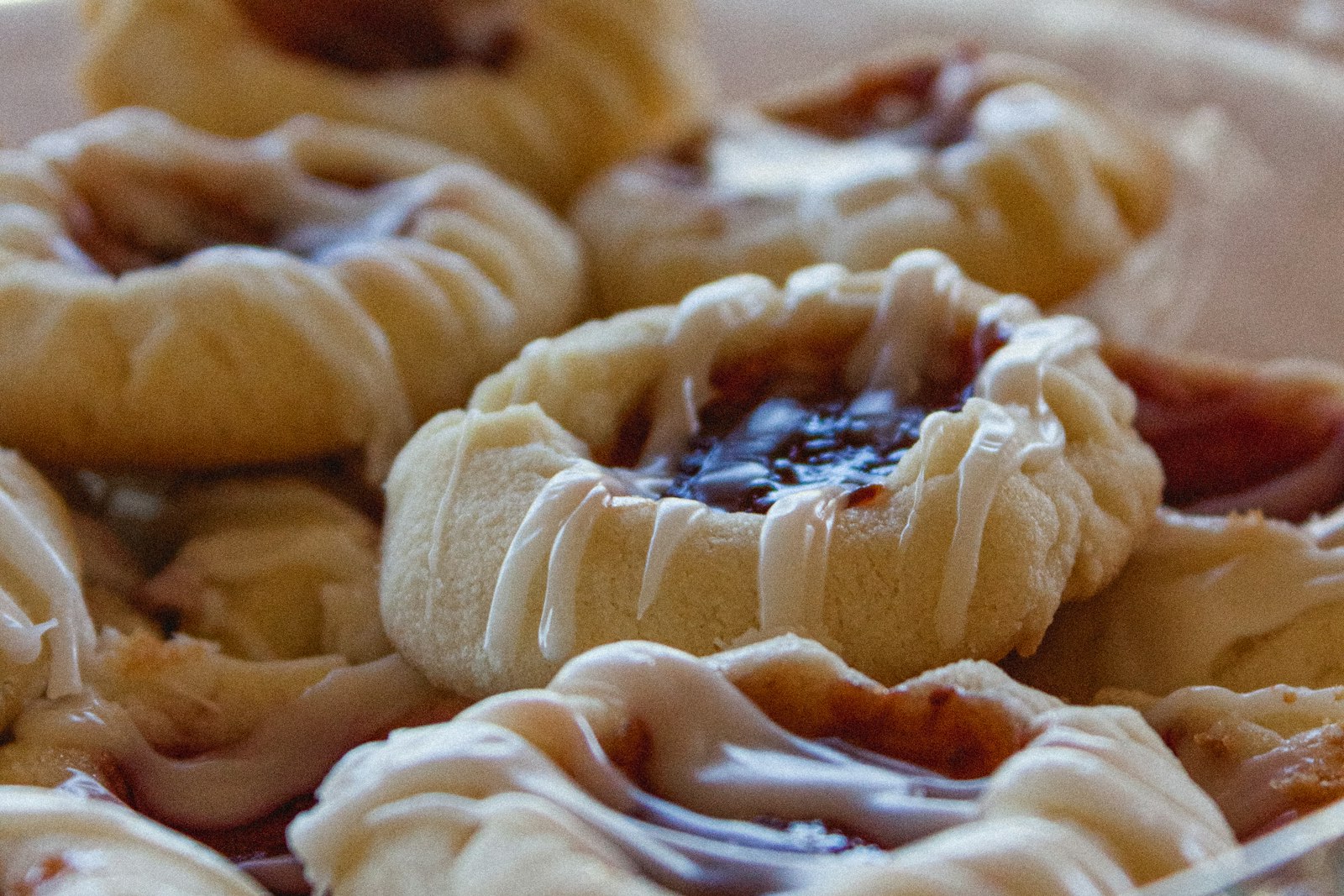
Thumbprint cookies are small rounds of rich egg-yolk butter dough, each pressed in the middle to make a well for jam. In this version the raspberry jam goes in before baking, so it thickens in the oven and sets firmly enough for the cookies to be stacked, and a thin icing drizzle is added once they are cool. Pressing the wells while the dough is still soft, then chilling the shaped cookies, stops the rims from cracking and the cookies from spreading.
Published
- Prep Time
- 30 mins
- Cook Time
- 30 mins
- Chill, cool and set
- 1 hr 30 mins
- Total Time
- 2 hrs 30 mins
- Servings
- about 30 cookies
How do you make Thumbprint Cookies?
To make thumbprint cookies, beat 225 g butter with 135 g sugar, 2 egg yolks and vanilla, then mix in 280 g flour and salt. Roll 22 g balls, press a well into each, chill for 30 minutes and fill with 1/2 tsp raspberry jam. Bake at 180°C (350°F) for 13-15 minutes, until the edges are light golden, then cool and drizzle with icing.
- Total time
- 2 hrs 30 mins
- Calories
- 125 per serving
- Protein
- 1 g
- Yield
- about 30 cookies
- Difficulty
- Easy
- Method
- Baking
Ingredients
Cookies
Filling
Icing drizzle
Equipment
Stand mixer or hand mixer · Mixing bowl · 2 small bowls · 2 baking sheets · Parchment paper · 1/2 teaspoon measuring spoon · Kitchen scale · Wire rack
Step-by-Step Instructions
Every step for making thumbprint cookies, written out in full.
Cream the butter and sugar
Beat the butter, granulated sugar and salt on medium speed for about 2 minutes, until pale and creamy. Add the egg yolks and vanilla and beat until blended, scraping the bowl once.
Add the flour
Tip in the flour and run the mixer on low until large clumps form and no dry flour is left at the bottom of the bowl. It should be soft and easy to shape without sticking to your fingers.
Shape the cookies and press the wells
Cover two baking sheets with parchment paper. Roll the dough into 22 g balls (a rounded tablespoon), smoothing away any creases, and space them 4 cm (1 1/2 inches) apart, 15 to a sheet. Press your thumb or the rounded back of a 1/2 teaspoon measure into the centre of each ball to make a well about 1 cm (1/2 inch) deep, stopping short of the bottom. Pinch together any cracks that open around the rim.
Chill
Refrigerate both sheets for 30 minutes, until the dough feels firm. Partway through, switch the oven on to 180°C (350°F).
Fill with jam
Stir the jam in a small bowl until it is loose and smooth. Spoon 1/2 tsp into each well so the jam sits level with the rim and no higher; it bubbles up as it heats.
Bake
Bake the sheets one after the other on the middle rack, 13-15 minutes each, until the edges and undersides of the cookies are light golden, the tops are still pale and the jam is bubbling around its edge. Leave the second sheet in the fridge until its turn.
Cool
Let the cookies sit on the sheet for 10 minutes, because the jam is very hot and the cookies are fragile, then lift them onto a wire rack and leave for about 20 minutes, until fully cool.
Drizzle with icing
Stir the icing sugar with 2 tsp of the milk until smooth, adding more milk a few drops at a time until the icing falls from the spoon in a thick ribbon. Drizzle it over the cooled cookies with a spoon or fork and leave for 30 minutes, until the icing is dry to the touch.
Recipe Tips
- Press the wells as soon as the dough is mixed. Dough that has already been chilled splits around the rim when you push into it.
- Use butter that is soft enough to dent but still cool. Greasy, half-melted butter makes the cookies spread and the wells flatten out.
- Choose a thick jam or preserve. Jelly and low-sugar fruit spreads turn runny in the oven and spill over the sides.
- Half a teaspoon of jam looks like too little, but more than that boils over and glues the cookies to the parchment.
- Wait until the icing has dried before stacking, and put parchment between the layers.
Variations
- Apricot or strawberry: swap the raspberry jam for 100 g (about 1/3 cup) of apricot or strawberry jam, chopping any large pieces of fruit first.
- Nut-coated: lightly beat 1 of the leftover egg whites, roll each ball in it and then in 100 g (a scant 1 cup) finely chopped walnuts or pecans before pressing the wells. Skip the icing.
- Lemon icing: stir the icing sugar with 2-3 tsp lemon juice in place of the milk.
- Chocolate-filled: bake the cookies with empty wells, pressing the wells down again with the spoon as soon as they come out of the oven. Once cool, fill them with 85 g (1/2 cup) semi-sweet chocolate chips, melted.
Nutrition (per serving)
| Calories | 125 |
|---|---|
| Protein | 1 g |
| Carbs | 16 g |
| Fat | 6.5 g |
| Saturated fat | 4 g |
| Fibre | 0.5 g |
| Sugar | 8 g |
| Sodium | 40 mg |
Estimated from the listed ingredients; values vary by brand.
Related Recipes

Storing & Reheating
- Fridge
- Once the icing has dried, layer the cookies between sheets of parchment in an airtight tin. They keep at room temperature for up to 5 days, so they can be baked 3-4 days before they are needed.
- Freezer
- Shape the dough and press the wells, freeze the unfilled cookies on a tray until solid and move them to a freezer bag, where they last 3 months. Fill them with jam while still frozen and give them 1-2 minutes longer in the oven. Without icing, the baked cookies freeze for up to 2 months; thaw at room temperature and drizzle them afterwards.
Thumbprint Cookies FAQs
Do you put the jam in thumbprint cookies before or after baking?
Before baking, for cookies that will be stacked or stored. In the oven some of the water in the jam cooks off, so the jam thickens and sets to a firm, slightly chewy centre that stays put in a tin. Jam spooned in after baking stays loose and glossy, smears when the cookies are stacked and softens the cookie underneath within a day.
Why do my thumbprint cookies crack when I press them?
The dough is too cold or too dry. Press the wells straight after mixing, while the dough is soft, and chill the cookies after shaping rather than before. Roll each ball until smooth, press slowly, and pinch any small cracks closed. If the dough still crumbles, there is too much flour in it, so weigh the flour next time.
Why did my thumbprint cookies spread flat?
The butter was too warm or the shaped cookies went into the oven without chilling. Start with butter that is soft but still cool, refrigerate the shaped cookies for 30 minutes and use baking sheets that are at room temperature. Beating the butter and sugar for much longer than 2 minutes also adds air that makes the cookies puff and then sink.
What kind of jam works in thumbprint cookies?
A thick jam or preserve with a normal amount of sugar. Raspberry, strawberry and apricot all bake well and set as they cool. Jelly melts and runs, and reduced-sugar spreads hold more water, so they stay wet. Stir the jam before spooning it in so it settles evenly in the well.
Why are thumbprint cookies made with egg yolks only?
Yolks add fat and bind the dough with far less water than egg whites bring. Less water means less steam and less puffing in the oven, so the cookies hold their shape and the wells stay deep enough for the jam. Yolks also give the cookies a richer, more tender crumb than a whole egg would.
Can I make thumbprint cookies ahead for Christmas?
Yes. Baked and iced thumbprint cookies stay fresh for up to 5 days at room temperature as long as the tin is airtight. For a longer lead time, freeze the shaped, unfilled cookies for up to 3 months, then fill them with jam and bake them from frozen with 1-2 extra minutes in the oven.
Disclaimer
- Nutrition information is an estimate based on the listed ingredients. It changes with the brands, portion sizes and swaps you use.
- Read ingredient labels for allergens and for diet claims such as gluten-free or vegan. Products and their ingredients can change.
- Cooking times are a guide, since ovens, air fryers and slow cookers all run differently. Use a food thermometer and cook meat, poultry and fish to the safe internal temperatures in government food safety guidance.
- This recipe is general information, not medical or nutrition advice. If you have an allergy, a health condition or a special diet, check with a qualified health professional.