Kimbap (Korean Seaweed Rice Rolls)
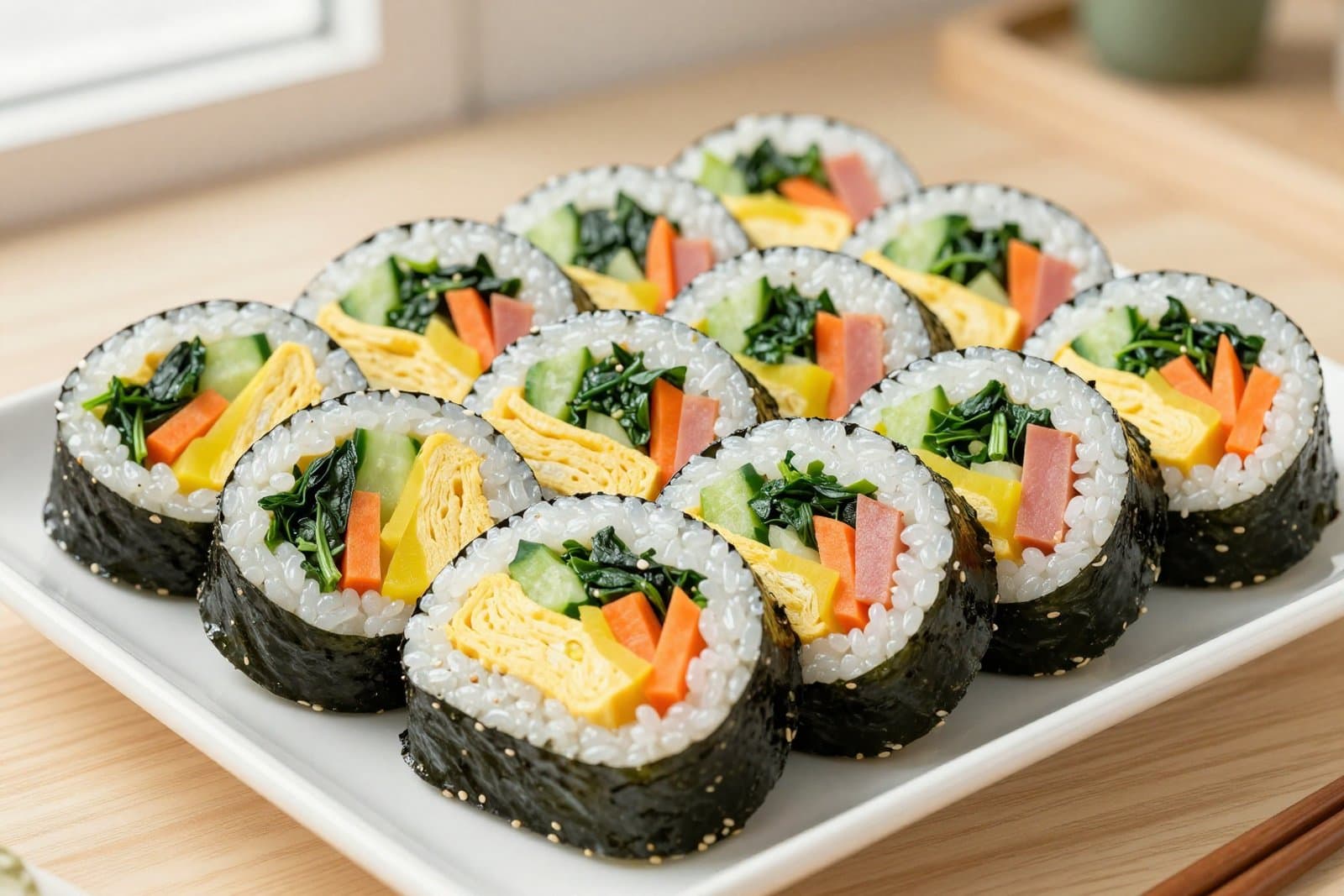
Slice a kimbap roll and every piece shows a ring of colours: thin omelette, sesame spinach, carrot, salted cucumber, yellow pickled radish and ham, wrapped in rice and roasted seaweed (gim is the seaweed, bap is rice). It looks like sushi but tastes different. The rice is seasoned with toasted sesame oil and salt instead of vinegar and sugar, and the fillings are cooked or pickled rather than raw fish. Korean families make it for picnics and school trips. Your first roll may come out lopsided; it tastes just as good, and the second is usually neater.
By Mei Lin Tan
Published
- Prep Time
- 40 mins
- Cook Time
- 25 mins
- Cool the rice
- 10 mins
- Total Time
- 1 hr 15 mins
- Servings
- 4 rolls
How do you make Kimbap (Korean Seaweed Rice Rolls)?
Cook 300 g short-grain rice, fold in 1 tbsp sesame oil and 1/2 tsp salt and cool it for 10 minutes until just warm. Fill each roll with strips of omelette from 4 eggs cooked through, blanched spinach, stir-fried carrot, salted cucumber, pickled radish and ham. Spread a quarter of the rice thinly over a sheet of roasted seaweed, roll tightly with a mat and cut into 8-10 slices.
- Total time
- 1 hr 15 mins
- Calories
- 520 per serving
- Protein
- 20 g
- Yield
- 4 rolls
- Difficulty
- Medium
- Method
- Rolling
Ingredients
Rice
Fillings
To roll
Equipment
Medium saucepan with a tight-fitting lid · Fine-mesh sieve · Medium pot · Non-stick skillet, 20-24 cm · Bamboo rolling mat or a clean tea towel · Large bowl and rice paddle or spatula · Sharp knife · Pastry brush
Quick Directions
Cook the rice
Rinse the rice, simmer it covered for 13 minutes and rest it for 10.
Prepare the vegetables
Salt the cucumber, blanch and season the spinach, and stir-fry the carrot.
Cook the omelette and ham
Cook two thin omelettes until set, cut them into strips and brown the ham.
Season the rice
Fold in the sesame oil and salt and cool the rice until just warm.
Roll the kimbap
Spread rice thinly over each seaweed sheet, line up the fillings and roll tightly.
Slice and serve
Brush with sesame oil, add sesame seeds and slice with a damp knife.
Step-by-Step Instructions
Every step for making kimbap (korean seaweed rice rolls), written out in full.
Cook the rice
Rinse the rice in a sieve under cold running water, swirling it with your hand, until the water runs almost clear, about 1 minute. Put it in the saucepan with the cold water and bring to the boil over high heat. Cover tightly, turn the heat to its lowest setting and cook for 13 minutes without lifting the lid. Turn off the heat and leave it covered to steam for 10 minutes.
Prepare the vegetables
While the rice cooks, toss the cucumber strips with 1/4 tsp salt and leave them for 10 minutes, then pat dry with paper towels. Bring a pot of water to the boil, blanch the spinach for 30 seconds, rinse it under cold water and squeeze it as dry as you can. Toss it with the garlic, 1 tsp sesame oil and a pinch of salt. Heat 1 tsp vegetable oil in the skillet over medium heat and stir-fry the carrot with a pinch of salt for 1-2 minutes, until it bends but still has some bite. Pat the pickled radish dry.
Cook the omelette and ham
Beat the eggs with a pinch of salt. Wipe the skillet, add 1/2 tsp vegetable oil and set it over medium-low heat. Pour in half the egg, tilt the pan so it spreads thin and cook for 2-3 minutes, until the top is set, then flip it and cook for 30 seconds more so it is cooked through. Repeat with another 1/2 tsp oil and the rest of the egg, then cut both omelettes into strips about 1 cm wide. Add the last 1 tsp oil and brown the ham strips for 1-2 minutes, turning them. Crab sticks go in straight from the pack.
Season the rice
Tip the hot rice into a large bowl, sprinkle with 1 tbsp sesame oil and 1/2 tsp salt and fold it through with a rice paddle, cutting into the rice rather than stirring so the grains stay whole. Spread it out and leave it for about 10 minutes, until it feels warm but no longer hot. Hot rice makes the seaweed shrink and wrinkle; cold rice won't stick.
Roll the kimbap
Lay a sheet of seaweed shiny side down on the mat, with the slats running side to side. With damp fingers, spread a quarter of the rice (about 165 g) in a thin, even layer over the sheet, leaving a 3 cm strip bare along the far edge. Lay a quarter of the egg, spinach, carrot, cucumber, radish and ham in neat lines across the rice, about 3 cm from the edge nearest you. Lift the near edge of the mat up and over the fillings, tuck them in with your fingertips, then keep rolling forward, squeezing gently along the length as you go. Press a few grains of rice onto the bare edge to seal it, and rest the roll seam side down while you make the other 3.
Slice and serve
Brush the rolls lightly with 1 tsp sesame oil and sprinkle with the sesame seeds. Wipe a sharp knife with a damp cloth and cut each roll into 8-10 slices about 2 cm thick, using long, gentle strokes and wiping the blade every few cuts so the rice doesn't drag. Serve at room temperature within 2 hours of cooking the rice. If it has to wait longer, refrigerate it or pack it cold with an ice pack (see Storage).
Recipe Tips
- Spread the rice no more than about 5 mm deep. With too much rice the roll won't close, or it splits when you slice it.
- Keep every filling dry. Squeezed spinach and patted-dry cucumber and radish stop the seaweed going soggy and tearing.
- Cut the fillings as long as the seaweed sheet is wide, so every slice gets some of each.
- No rolling mat? A clean tea towel works the same way. Lay a sheet of plastic wrap over either one if you want to keep it free of rice.
Variations
- Tuna mayo kimbap: replace the ham with a 150 g can of tuna, drained and mixed with 2 tbsp mayonnaise. Spoon it onto a lettuce leaf on the rice so the mayonnaise doesn't soak the seaweed.
- Beef kimbap: replace the ham with about 200 g cooked beef bulgogi, well drained and cut into strips.
- Vegetarian kimbap: leave out the ham and use 200 g firm tofu cut into 1 cm strips and patted dry. Pan-fry them in 2 tsp vegetable oil over medium-high heat for 6-8 minutes, turning, until golden on all sides, then toss with 1 tsp soy sauce.
Nutrition (per serving)
| Calories | 520 |
|---|---|
| Protein | 20 g |
| Carbs | 70 g |
| Fat | 17 g |
| Saturated fat | 3 g |
| Fibre | 4 g |
| Sugar | 4 g |
| Sodium | 1340 mg |
Estimated from the listed ingredients; values vary by brand.
Related Recipes
Storing & Reheating
- Fridge
- Cool quickly and refrigerate within 1 hour if you can, and no later than 2 hours after cooking. Kimbap is best the day it's made. If you won't eat it within 2 hours of cooking the rice, refrigerate the rolls as soon as they're made, and pack them with an ice pack only once they are cold. Wrap leftover rolls tightly and refrigerate for up to 1 day. The rice hardens in the fridge.
- Reheat
- Revive cold slices by dipping them in beaten egg (1 egg covers about 10 slices) and pan-frying them in 1 tbsp oil over medium heat for 2-3 minutes a side, until the egg is set and the rice is soft, steaming and 74°C (165°F). Reheat once only.
Kimbap (Korean Seaweed Rice Rolls) FAQs
What is the difference between kimbap and sushi?
Both are rice rolled in seaweed, but kimbap rice is seasoned with toasted sesame oil and salt, while sushi rice is seasoned with vinegar, sugar and salt. Kimbap fillings are cooked, pickled or cured, such as omelette, spinach, carrot, pickled radish and ham, rather than raw fish, and the rolls are brushed with sesame oil and sprinkled with sesame seeds.
What is the yellow pickle in kimbap?
It is danmuji, Korean radish pickled in a sweet brine and coloured bright yellow. Asian grocers sell it in strips already cut to the length of a kimbap roll. It adds crunch and a sweet-sour bite. If you can't find it, use long strips of pickled cucumber, or leave it out.
Why does my kimbap fall apart when I slice it?
Usually the rice is too thick, the roll is loose or the knife is dry. Spread the rice about 5 mm thick, squeeze gently along the roll as you go, rest it seam side down for a few minutes, and slice with a sharp, damp knife using long, gentle strokes instead of pressing down.
Can I make kimbap the night before?
It is best made the same day. Wrapped and refrigerated, the rolls keep for up to 1 day, but the rice turns firm and dry. For a packed lunch, roll it in the morning, chill it in the fridge until cold, then pack it with an ice pack. Leftover slices are good dipped in beaten egg and pan-fried until the egg is set.
Disclaimer
- Nutrition information is an estimate based on the listed ingredients. It changes with the brands, portion sizes and swaps you use.
- Read ingredient labels for allergens and for diet claims such as gluten-free or vegan. Products and their ingredients can change.
- Cooking times are a guide, since ovens, air fryers and slow cookers all run differently. Use a food thermometer and cook meat, poultry and fish to the safe internal temperatures in government food safety guidance.
- This recipe is general information, not medical or nutrition advice. If you have an allergy, a health condition or a special diet, check with a qualified health professional.