Mandu (Korean Pork and Tofu Dumplings)
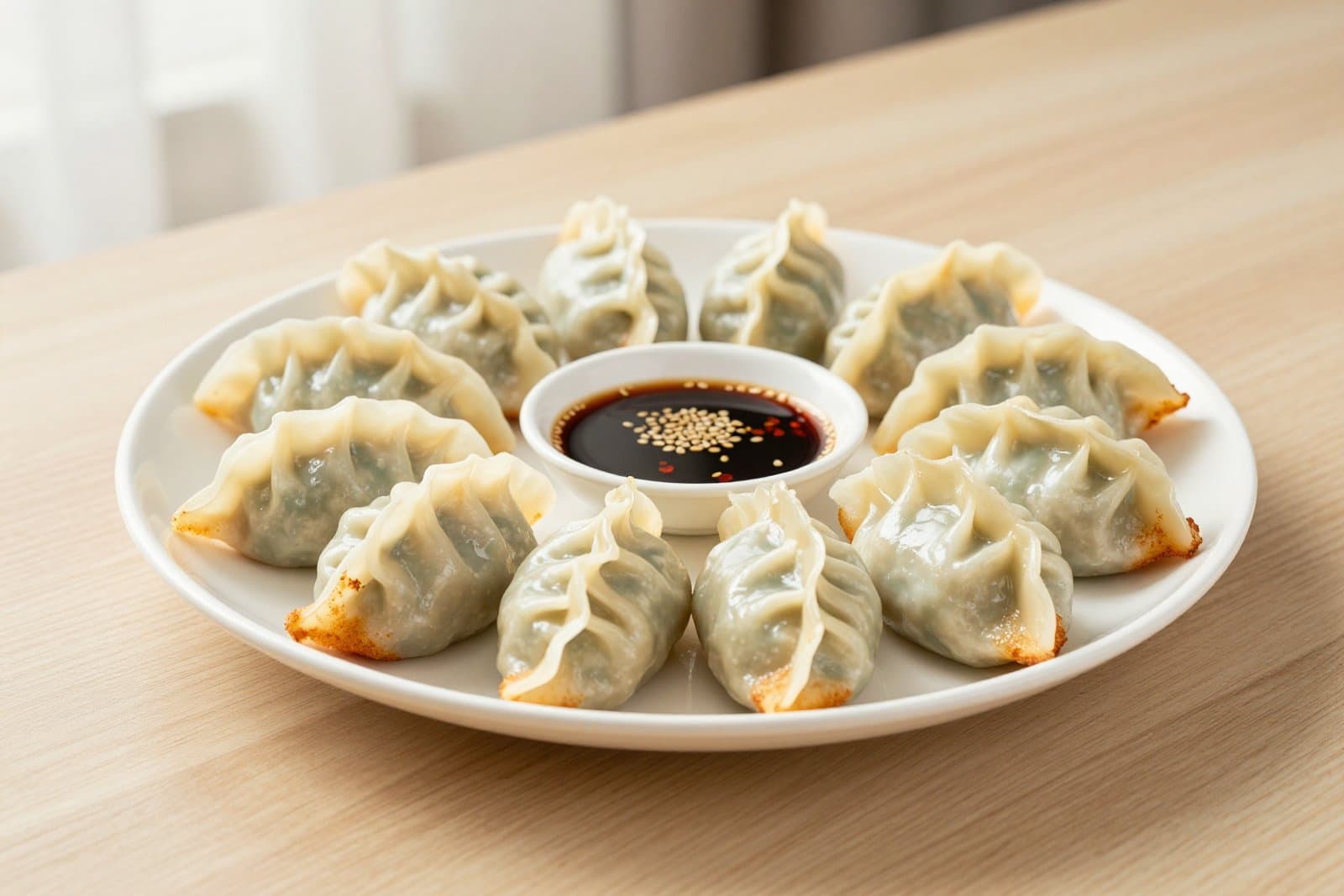
Mandu is the Korean word for dumplings. Around Seollal, the Lunar New Year, families often fold them by the trayful and drop some into tteokguk, the rice cake soup eaten on New Year's morning. Here the filling mixes ground pork with crumbled tofu, chopped sweet potato glass noodles and cabbage, so it stays juicy and light, with a little chew from the noodles. Plain half-moons are the quickest shape to fold. Fry them until the bottoms crunch, then let them steam in the same pan, or freeze the batch and cook a handful straight from the freezer.
By Mei Lin Tan
Published
- Prep Time
- 1 hr 10 mins
- Cook Time
- 40 mins
- Total Time
- 1 hr 50 mins
- Servings
- About 40 dumplings
How do you make Mandu (Korean Pork and Tofu Dumplings)?
Mix 300 g ground pork with 200 g squeezed firm tofu, boiled and chopped glass noodles, salted cabbage, green onions, garlic, ginger, soy sauce and sesame oil. Fold into about 40 half-moons with round wrappers. Brown 13-14 at a time, splash in 60 ml water and let them steam under a lid until the filling hits 71°C (160°F), 6-7 minutes. Uncover for a final minute or two.
- Total time
- 1 hr 50 mins
- Calories
- 340 per serving
- Protein
- 15 g
- Yield
- About 40 dumplings
- Difficulty
- Medium
- Method
- Pan-frying
Ingredients
Filling
Wrapping and cooking
Dipping sauce
Equipment
Large non-stick frying pan with a lid, about 30 cm · Small saucepan · Sieve or colander · Medium bowl · Large mixing bowl · Clean tea towels · Baking tray · Instant-read thermometer · Small bowl
Quick Directions
Cook the noodles and salt the cabbage
Boil the noodles for 6-7 minutes and salt the cabbage for 15 minutes.
Squeeze everything dry
Wring the tofu and cabbage dry and chop the noodles.
Mix the filling
Mix the pork, tofu, noodles, cabbage and seasonings until sticky.
Fold the half-moons
Fill each wrapper with about 20 g of filling, fold into a half-moon and seal.
Pan-fry, then steam
Brown in 3 batches, steaming each under a lid with 60 ml water until the filling hits 71°C (160°F).
Make the dip and serve
Mix the soy and vinegar dip and serve the mandu hot.
Step-by-Step Instructions
Every step for making mandu (korean pork and tofu dumplings), written out in full.
Cook the noodles and salt the cabbage
Bring the small saucepan of water to the boil and cook the noodles for 6-7 minutes, stirring once or twice, until soft but still springy. Drain them, rinse under cold water and leave them in the sieve or colander. Meanwhile, in the medium bowl, sprinkle 1/2 tsp of the salt over the chopped cabbage, toss and set it aside for 15 minutes; the salt pulls out water that you'll squeeze away later.
Squeeze everything dry
Bundle the tofu in a clean tea towel, twist the ends and wring it out over the sink until it has crumbled and stops dripping, then tip it into the large mixing bowl. Wring the cabbage out the same way, a handful at a time, and add it to the tofu. Shake the noodles dry and chop them into 1 cm pieces.
Mix the filling
Add the chopped noodles, pork, green onions, garlic, ginger, 1 tbsp soy sauce, sesame oil, black pepper and the remaining 1/2 tsp salt to the bowl. Mix with your hand for 1-2 minutes, squeezing the mixture through your fingers, until it is evenly combined and sticky enough to hold together in a ball.
Fold the half-moons
Dust the baking tray with flour and set out the small bowl filled with water. Hold a wrapper flat on your palm, spoon a heaped tablespoon (about 20 g) of filling onto the middle and dab water around half of the rim with a fingertip. Fold the wrapper over into a half-moon and press the edges together from one end to the other, pushing out any air, so it seals tightly. Stand it seam up on the tray and press it down lightly so the bottom sits flat. Carry on with the rest of the wrappers and filling, draping a tea towel over the filled tray and the pile of unused wrappers as you go; their edges crack in the open air and then refuse to stick. To make the mandu ahead, put the whole tray in the freezer at this point.
Pan-fry, then steam
Warm a third of the oil (1 tbsp) in the frying pan on a medium-high burner. When it shimmers, stand 13-14 dumplings upright, seams pointing up, in a loose ring with the last few in the middle, leaving a small gap between each. Leave them to sizzle, untouched, until their bases are golden, about 2 minutes. Pour in a third of the water (60 ml), keeping your face back because it spits, put the lid on at once and lower the heat to medium. After 6-7 minutes the wrappers will have turned see-through; push a thermometer into the centre of one dumpling's filling and look for 71°C (160°F). Take the lid off and let the last of the water bubble away for 1-2 minutes so the bases turn crisp. Lift the batch out with a spatula, then cook the other two batches the same way, with 1 tbsp oil and 60 ml water each time.
Make the dip and serve
In the small bowl, combine the 3 tbsp soy sauce with the rice vinegar, sugar, sesame seeds and the gochugaru, if you're using it, and stir until the sugar has gone. Bring each batch to the table hot, as soon as it leaves the pan, with the dip alongside.
Recipe Tips
- Wring the tofu and cabbage until nothing more drips. Water left in the filling seeps into the wrappers from the inside, and soggy wrappers split in the pan.
- Before folding all 40, taste a little of the filling: microwave a teaspoon of it on a plate for 30-40 seconds, until no pink remains, then add more salt or soy sauce if it tastes flat.
- For boiled mandu (mul-mandu), bring plenty of water to a fierce boil in your biggest pot, slide in 15-20 dumplings and give them a gentle stir straight away so none settle on the base. They need 5-6 minutes: they're ready once they bob up to the surface, the wrappers look a little swollen and a thermometer in the filling reads 71°C (160°F). Scoop them out with a slotted spoon.
- Seal each half-moon from one end to the other, chasing the air out ahead of your fingers. Air trapped inside swells as the dumplings steam and can burst the seam.
Variations
- Kimchi mandu: replace the cabbage with 200 g well-fermented kimchi, finely chopped and squeezed dry, skip salting it and use only a pinch of salt in the filling. The result is sour, savoury and spicy, so it's no longer one for young children.
- Dumpling soup (mandu-guk): bring 1.5 litres of beef or chicken stock to a simmer with 1 tbsp soy sauce, add 15-20 dumplings and simmer for 6-7 minutes, until they float and the filling reaches 71°C (160°F). Serve in bowls with sliced green onions.
- Steamed mandu: line a steamer basket with baking paper or cabbage leaves, set the dumplings in with a little space between them and steam over boiling water for 10-12 minutes, until the filling reaches 71°C (160°F).
Nutrition (per serving)
| Calories | 340 |
|---|---|
| Protein | 15 g |
| Carbs | 30 g |
| Fat | 17 g |
| Saturated fat | 4 g |
| Fibre | 2 g |
| Sugar | 1 g |
| Sodium | 870 mg |
Estimated from the listed ingredients; values vary by brand.
Related Recipes
Storing & Reheating
- Fridge
- Cooked mandu keep for up to 3 days in a sealed container in the fridge; get them in there within 2 hours of cooking. The mixed filling can wait, covered, in the fridge for up to 1 day. Folded raw dumplings can't: their wrappers soak up moisture from the filling and turn sticky, so cook or freeze them on the day you fold them.
- Freezer
- Put the tray of raw mandu in the freezer, spaced apart so they don't fuse, for about 2 hours until rock hard. Move them into freezer bags, press out the air and freeze for up to 3 months. Cook them still frozen, allowing 2-3 extra minutes: after browning, 8-9 minutes under the lid with 80 ml water, or 8-9 minutes in boiling water. Either way, the filling should read 71°C (160°F).
- Reheat
- Put leftover mandu in a frying pan with a few drops of oil and 2 tbsp water, cover and warm over medium heat for 4-5 minutes; a steamer basket over boiling water takes about 5. Either way, heat them until steaming hot and 74°C (165°F) in the centre.
Mandu (Korean Pork and Tofu Dumplings) FAQs
What makes mandu different from other dumplings?
Mostly the filling: tofu and chopped sweet potato glass noodles often go in with the meat, and kimchi is a popular addition. Mandu are steamed (jjin-mandu), pan-fried (gun-mandu), boiled (mul-mandu) or simmered in soup (mandu-guk).
Why add tofu and glass noodles to the filling?
Tofu makes the filling softer and lighter and stretches the pork further. The chopped noodles soak up juices as the dumplings cook, so less liquid reaches the wrappers, and they add a slight chewy bite. Squeeze the tofu very dry first, or the filling turns wet.
How can I tell mandu are cooked through?
Look for wrappers that have gone from opaque white to see-through and a filling that springs back when pressed. Those signs are a good guide, but a thermometer is the sure test: slide it into the centre of one dumpling per batch and look for 71°C (160°F), the safe temperature for ground pork.
Can I cook mandu straight from frozen?
Yes, and it's the easiest way. Go straight from freezer to pan, because thawed mandu turn soggy and stick together. Brown them, then give them 8-9 minutes under the lid with 80 ml water instead of 6-7; boiled, they need 8-9 minutes instead of 5-6. Check that the filling reaches 71°C (160°F).
Disclaimer
- Nutrition information is an estimate based on the listed ingredients. It changes with the brands, portion sizes and swaps you use.
- Read ingredient labels for allergens and for diet claims such as gluten-free or vegan. Products and their ingredients can change.
- Cooking times are a guide, since ovens, air fryers and slow cookers all run differently. Use a food thermometer and cook meat, poultry and fish to the safe internal temperatures in government food safety guidance.
- This recipe is general information, not medical or nutrition advice. If you have an allergy, a health condition or a special diet, check with a qualified health professional.