Thai Vegetable Spring Rolls (Por Pia Tod)
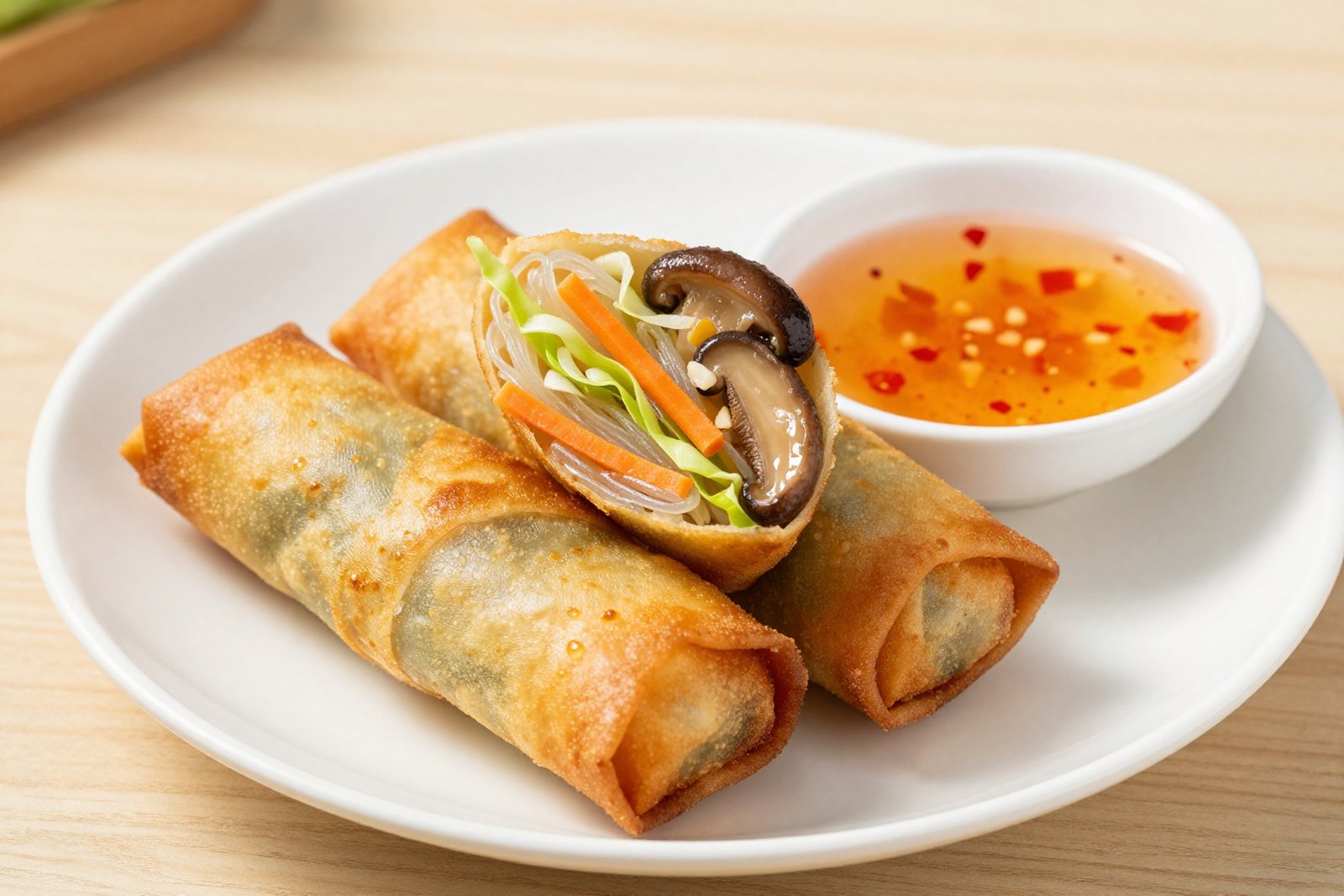
Por pia tod are the crackly fried spring rolls sold at Thai markets and served as a starter all over Thailand. The name comes from popiah, the Teochew and Hokkien word for a spring roll, and the dish arrived with Chinese cooks; tod means fried. Thin wheat pastry is wrapped around a cooked filling of glass noodles, cabbage, carrot and shiitake seasoned with garlic, white pepper, soy sauce and a vegetarian mushroom sauce in place of oyster sauce, which with egg-free wrappers keeps them vegan. Cooling and draining the filling before rolling is what keeps the pastry whole and crisp in the oil.
By Mei Lin Tan
Published
- Prep Time
- 45 mins
- Cook Time
- 40 mins
- Soak and cool
- 35 mins
- Total Time
- 2 hrs
- Servings
- 20 rolls
How do you make Thai Vegetable Spring Rolls (Por Pia Tod)?
Stir-fry soaked glass noodles and shiitake with garlic, 300 g shredded cabbage and a carrot, seasoned with soy sauce, mushroom sauce and white pepper. Cool and drain the filling, roll it in 20 wheat spring roll wrappers and seal with flour paste. Fry 5 at a time in oil 5 cm deep at 175°C (350°F) for 4-5 minutes, until golden.
- Total time
- 2 hrs
- Calories
- 525 per serving
- Protein
- 6 g
- Yield
- 20 rolls
- Difficulty
- Medium
- Method
- Deep frying
Ingredients
Filling
Wrapping
Frying
Sweet chilli sauce
Equipment
2 heatproof bowls · Wok or large skillet · Rimmed baking tray · Sieve · Small saucepan · Heavy pot about 20 cm (8 in) wide and at least 10 cm (4 in) deep · Deep-fry thermometer · Tongs and a wire rack set over a tray
Step-by-Step Instructions
Every step for making thai vegetable spring rolls (por pia tod), written out in full.
Soak the noodles and mushrooms
Put the shiitake in a heatproof bowl, cover with just-boiled water and soak for 20 minutes, until soft all the way through. Soak the glass noodles in warm tap water in a second bowl for 10 minutes. Drain both. Squeeze the mushrooms dry, cut off and discard the tough stems, and slice the caps thinly. Snip the noodles into 5 cm (2 in) lengths with kitchen scissors. Shred the cabbage and cut the carrot while they soak.
Make the sweet chilli sauce
Wearing gloves or washing your hands well afterwards, finely chop the chillies. Each bird's eye chilli adds a clear, sharp heat: use 2 for a gentle sauce and 4 for a hot one, or one Fresno for the mildest. Simmer the vinegar, water, sugar, garlic, chillies and salt in a small saucepan over medium heat for 5 minutes, stirring until the sugar dissolves. Stir in the cornstarch mixture and simmer for 1 minute more, until it thickens slightly. It thickens further as it cools. Or use 175 ml (3/4 cup) store-bought Thai sweet chilli sauce, checking the label for fish sauce if you need it vegan.
Cook the filling
Heat the 2 tbsp oil in a wok or large skillet over medium-high heat. Stir-fry the garlic for 30 seconds, until fragrant but not brown, then add the mushrooms for 1 minute. Add the cabbage and carrot and stir-fry for 3-4 minutes, until just wilted. Add the noodles, soy sauce, mushroom sauce, sugar and white pepper and toss for 1-2 minutes, until the noodles are coated and the pan is almost dry.
Cool and drain the filling
Spread the filling on a rimmed tray and let it cool for about 15 minutes, to room temperature. Tip it into a sieve and press firmly with the back of a spoon to squeeze out the liquid. A warm or wet filling softens the pastry, splits the rolls as you fry them and makes the oil spit.
Roll the spring rolls
Stir the flour and water into a smooth, thick paste. Peel the wrappers apart and keep the stack under a damp tea towel, because they dry and crack quickly. Lay one wrapper with a corner pointing towards you. Shape a heaped 2 tbsp of filling into a 10 cm (4 in) log across the lower third. Fold the bottom corner over the filling and roll once, tightly. Fold in both sides, then roll up firmly towards the top corner. Dab flour paste on the last corner and press it down so the roll stays shut. Put the roll on a tray with the sealed edge underneath, cover with a dry towel, and carry on until all 20 are rolled.
Heat the oil
Pour the 1.5 L oil into a heavy pot about 20 cm (8 in) wide, to a depth of about 5 cm (2 in); the pot should be no more than half full. Heat over medium heat to 175°C (350°F) on a deep-fry thermometer, about 10 minutes. Keep a lid and a dry tray nearby, keep water away from the pot, and never leave the hot oil unattended.
Fry in batches
Lower 5 rolls into the oil with tongs, one at a time and away from you, so you fry the 20 rolls in 4 batches. Fry for 4-5 minutes, turning them now and then, until golden brown, blistered and crisp all over. The filling is already cooked, so you are crisping the pastry and heating the filling through. Lift them onto the wire rack to drain. Adjust the heat to hold 175°C (350°F) and let the oil come back to temperature, about 1 minute, before the next batch.
Serve
Serve the spring rolls hot, whole or cut in half on the diagonal, with the sweet chilli sauce for dipping. Turn off the heat and let the oil cool completely in the pot before straining it to reuse or pouring it into a sealed container to throw away.
Recipe Tips
- Square spring roll pastry is sold frozen at Asian grocers, usually labelled spring roll pastry or spring roll wrappers. Thaw the sealed pack in the fridge overnight or on the counter for about 30 minutes; frozen sheets tear when you peel them apart.
- Roll tightly and keep each roll slim. Air pockets fill with oil, and thick rolls brown outside before the middle is hot.
- Let the fried rolls rest on a wire rack, not on paper towels: air reaches the underside, so the pastry there stays crunchy instead of going soft in its own steam.
- Keep the oil at 175°C (350°F). Too cool and the rolls soak up oil and turn greasy; too hot and the pastry darkens before it crisps.
- Glass noodles look like rice vermicelli but are made from mung bean starch and turn clear when cooked. Rice vermicelli works in a pinch, though it is softer.
Variations
- Air fryer: brush or spray the rolls all over with oil and air fry at 200°C (400°F) for 8-10 minutes, turning halfway, until golden. They come out crisp but less blistered than deep-fried rolls.
- Add 100 g bean sprouts or a handful of finely shredded green onions to the filling with the cabbage.
- Not vegan: replace the mushroom sauce with oyster sauce and add 150 g finely chopped cooked shrimp to the cooled filling.
Nutrition (per serving)
| Calories | 525 |
|---|---|
| Protein | 6 g |
| Carbs | 74 g |
| Fat | 23 g |
| Saturated fat | 2 g |
| Fibre | 3.5 g |
| Sugar | 24 g |
| Sodium | 810 mg |
Estimated from the listed ingredients; values vary by brand.
Related Recipes
Storing & Reheating
- Fridge
- Refrigerate fried spring rolls within 2 hours in an airtight container for up to 3 days. The cooked filling keeps covered in the fridge for up to 1 day, so you can make it the day before you roll. The sweet chilli sauce keeps in a jar in the fridge for up to 2 weeks.
- Freezer
- Freeze uncooked rolls in a single layer on a lined tray, not touching, until firm, then pack them into a freezer bag for up to 2 months. Fry them straight from frozen, without thawing: brush off any ice crystals so the oil does not spit, then fry 4 at a time in oil 5 cm deep at 175°C (350°F) for 6-8 minutes, 2-3 minutes longer than fresh, until deep golden. Cut the first one in half: the filling should be steaming hot all the way through; if it is not, fry the next batch a minute longer. Fried rolls lose their crunch in the freezer.
- Reheat
- Re-crisp fried rolls on a rack in a 200°C (400°F) oven or air fryer for 6-8 minutes, until the pastry crackles again and the filling is steaming hot all the way through, 74°C (165°F) on a thin probe pushed in from one end. A microwave turns the pastry soft and chewy.
Thai Vegetable Spring Rolls (Por Pia Tod) FAQs
What is the difference between por pia tod and fresh spring rolls?
Por pia tod are wrapped in thin wheat pastry around a cooked filling and deep-fried until crisp, then eaten hot. Fresh spring rolls, such as Vietnamese goi cuon or Thai por pia sod, are not fried: soft rice paper or a thin crepe is wrapped around cool fillings and served at room temperature.
Can I freeze Thai spring rolls before frying?
Yes, and they fry well straight from the freezer. Spread the rolled, uncooked rolls out on a tray lined with parchment, freeze until hard, then move them to a freezer bag and use within 2 months. Without thawing, brush off any ice and fry them 4 at a time, at 175°C (350°F) in oil 5 cm deep for 6-8 minutes, until deep golden and steaming hot in the centre when you cut one open.
Are these spring rolls vegan and gluten-free?
They are vegan when the wrappers contain no egg and the mushroom stir-fry sauce and any store-bought sweet chilli sauce are labelled vegan, since some brands add egg, oyster or fish sauce. They are not gluten-free: the wrappers are wheat pastry, and regular soy sauce also contains wheat.
Why did my spring rolls split or come out greasy?
Splitting usually comes from a filling that was still warm or wet, or from rolling too loosely. Greasy rolls mean the oil was too cool or the pot was crowded. Cool and press the filling dry, roll tightly, fry no more than 5 at a time and let the oil return to 175°C (350°F) between batches.
Can you bake Thai spring rolls instead of frying them?
Yes. Brush the rolls all over with oil, set them on a lined tray and bake at 200°C (400°F) for 20-25 minutes, turning once halfway, until golden. The pastry turns crisp but drier and less blistered than in deep-fried rolls.
Disclaimer
- Nutrition information is an estimate based on the listed ingredients. It changes with the brands, portion sizes and swaps you use.
- Read ingredient labels for allergens and for diet claims such as gluten-free or vegan. Products and their ingredients can change.
- Cooking times are a guide, since ovens, air fryers and slow cookers all run differently. Use a food thermometer and cook meat, poultry and fish to the safe internal temperatures in government food safety guidance.
- This recipe is general information, not medical or nutrition advice. If you have an allergy, a health condition or a special diet, check with a qualified health professional.