Massaman Beef Curry
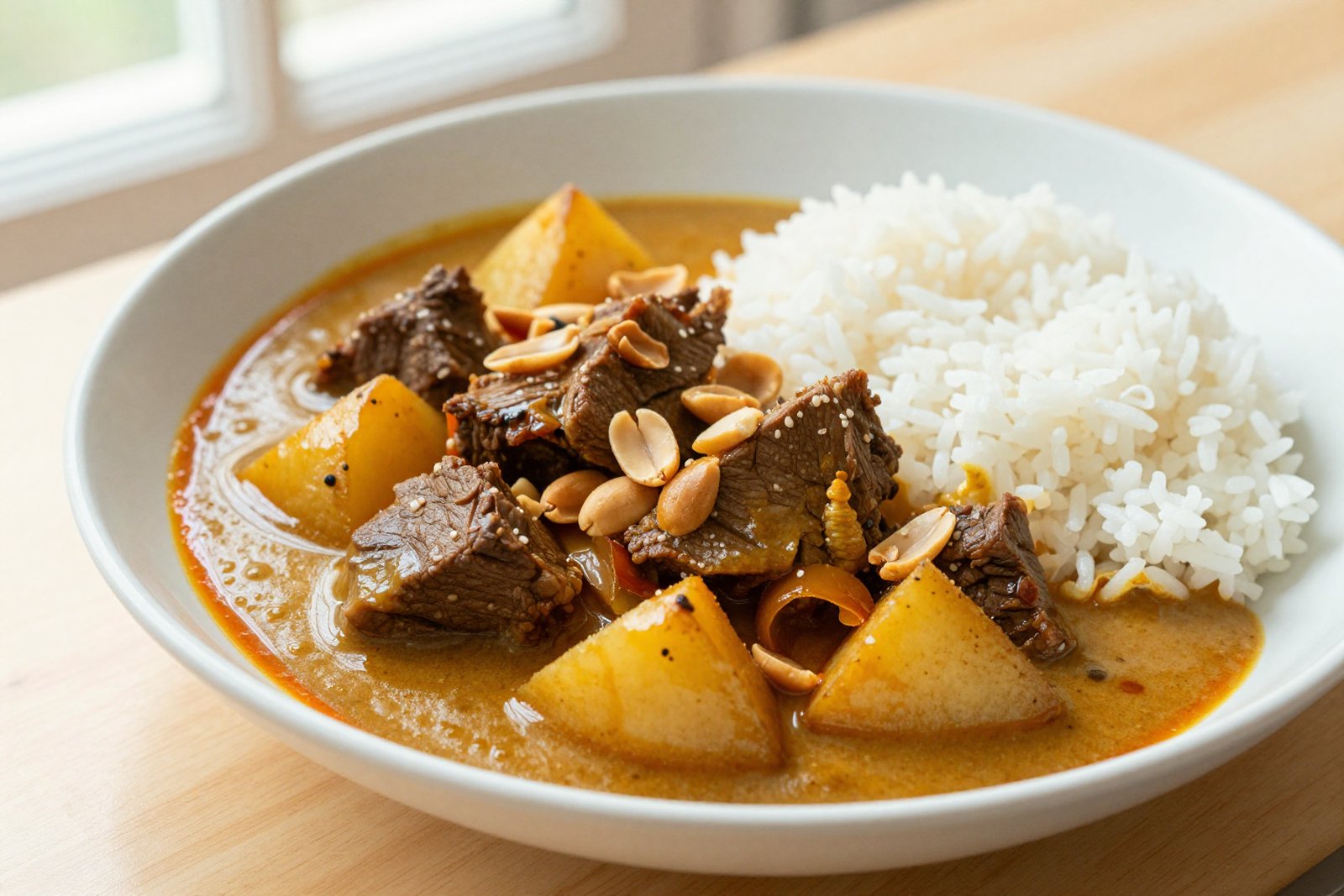
Massaman curry (kaeng matsaman, also written mussaman) is the mildest and most spice-scented of the Thai coconut curries. Its paste pairs dried red chillies, lemongrass, galangal, shallot and garlic with cumin, coriander seed, cinnamon and clove, and the name is usually traced to Persian or Muslim traders and cooks, though accounts differ. Here chunks of beef chuck braise slowly in coconut milk with cinnamon, cardamom and bay, and the potatoes, onion and roasted peanuts join for the last hour so they hold their shape. A store-bought massaman paste stands in for the pounded homemade kind, and tamarind and palm sugar give the sauce its sweet-sour finish.
By Mei Lin Tan
Published
- Prep Time
- 25 mins
- Cook Time
- 2 hrs 30 mins
- Total Time
- 2 hrs 55 mins
- Servings
- 6 servings
How do you make Massaman Beef Curry?
Fry 4-5 tbsp massaman paste in 250 ml thick coconut cream reduced until its oil separates, then coat 1 kg beef chuck chunks in it. Add the rest of 800 ml coconut milk, 500 ml water, cinnamon, cardamom and bay and simmer gently for 1 1/4 hours. Add potatoes, onion, peanuts, tamarind, palm sugar and fish sauce and cook 45-60 minutes more, until a fork slides easily into the beef.
- Total time
- 2 hrs 55 mins
- Calories
- 810 per serving
- Protein
- 40 g
- Yield
- 6 servings
- Difficulty
- Easy
- Method
- Braising
Ingredients
Beef and sauce
Potatoes and seasoning
To serve
Equipment
Large Dutch oven or heavy pot with a lid (at least 5 L / 5 quarts) · Wooden spoon · Fork for testing tenderness
Step-by-Step Instructions
Every step for making massaman beef curry, written out in full.
Cut the beef and vegetables
Cut the beef into 4-5 cm chunks, trimming off any thick pieces of hard fat or gristle, and pat it dry with paper towels. Peel the potatoes, cut them into 4 cm chunks and leave them in a bowl of cold water so they don't brown. Cut the onion into 8 wedges, keeping a little of the root on each so they stay together. Wash your hands and the board after handling the raw beef.
Reduce the coconut cream
Open both cans of coconut milk without shaking them and spoon off the thick cream from the top, about 250 ml (1 cup) in all. Put it in the Dutch oven over medium heat and let it bubble for 5-8 minutes, stirring often, until it thickens, looks oily and small pools of clear fat appear. If it stays smooth and white, stir in the optional oil and carry on.
Fry the massaman paste
Add 4 tbsp of the curry paste and fry it in the separated cream for 3-4 minutes, stirring and scraping the bottom constantly, until it turns a deep brick red and smells of cinnamon and cumin. Lower the heat if it starts to catch. Add the fifth spoonful now if you know your paste is mild.
Start the braise
Add the beef and turn it in the paste for 3-4 minutes, until every piece is coated and the outsides no longer look raw. Stir in the thinner coconut milk left in the cans along with the water, followed by the cinnamon stick, cardamom pods and bay leaves. Bring it up to a simmer, then turn the heat to low, set the lid on slightly ajar and cook for 1 1/4 hours, stirring every 20 minutes or so. Keep it at a lazy simmer with only a few bubbles breaking the surface; a hard boil tightens the meat and splits the coconut milk.
Add the potatoes and seasoning
Drain the potatoes and add them to the pot with the onion wedges, all but a small handful of the peanuts, the tamarind paste, 2 tbsp palm sugar and the fish sauce. Push everything under the sauce, adding up to 125 ml (1/2 cup) water if the potatoes are not covered. Simmer uncovered over low heat for 45-60 minutes, stirring gently now and then so the potatoes don't break up, until the potatoes are tender and the sauce has thickened.
Check the beef
The curry is ready when a fork slides into a chunk of beef with almost no resistance and the meat pulls apart when pressed against the side of the pot. Chuck varies, so if the beef still feels springy, keep simmering and check again every 15 minutes. If the potatoes are done first, lift them out with a slotted spoon and return them at the end.
Season and serve
Taste the sauce: it should be rich and gently spiced, salty-sweet with a soft sour edge from the tamarind. Adjust with more fish sauce, the remaining palm sugar or a little more tamarind. Fish out the cinnamon stick, cardamom pods and bay leaves, which are not eaten, and skim off some of the orange oil from the top if you prefer a lighter sauce. Serve with jasmine rice and scatter the reserved peanuts on top.
Recipe Tips
- Pick waxy or all-purpose potatoes. Floury baking potatoes collapse during the long simmer and turn the sauce gluey.
- Massaman pastes differ in salt, sweetness and heat from brand to brand. Start with 4 tbsp and hold back on the fish sauce until you taste the finished curry.
- Tamarind comes in different strengths. Thick seedless paste is used as written; dark, runny concentrate is stronger, so start with 1 tbsp. From a block of pulp, soak 30 g in 90 ml hot water for 10 minutes, squeeze it through your fingers, strain and use 3 tbsp of the liquid.
- Count the cardamom pods in so you can count them out again. Biting into a whole pod or a shard of cinnamon is unpleasant.
- For a gluten-free curry, check the labels on the curry paste, fish sauce, tamarind and any stock you use, since a few brands contain wheat.
Variations
- Chicken massaman: use 1.2 kg bone-in chicken thighs or drumsticks instead of beef. Simmer for 20 minutes before adding the potatoes, then for 25-30 minutes more, until the potatoes are tender and the chicken reaches 74°C (165°F) next to the bone.
- Lamb: boneless lamb shoulder in 4-5 cm chunks takes about the same time as beef. Test it with a fork in the same way.
- Sweet potato: swap half the potatoes for sweet potato in 4 cm chunks and add it for only the last 20-25 minutes, because it softens much faster than potato.
Nutrition (per serving)
| Calories | 810 |
|---|---|
| Protein | 40 g |
| Carbs | 37 g |
| Fat | 56 g |
| Saturated fat | 35 g |
| Fibre | 4.5 g |
| Sugar | 14 g |
| Sodium | 900 mg |
Estimated from the listed ingredients; values vary by brand.
Related Recipes
Storing & Reheating
- Fridge
- Refrigerate within 2 hours in an airtight container for up to 4 days. Massaman curry can be made a day ahead: the sauce thickens and the spices mellow overnight, so loosen it with a splash of water when you reheat it. Cool leftover rice quickly and refrigerate within 1 hour if you can, and no later than 2 hours after cooking. Eat within 3 days.
- Freezer
- The beef and sauce freeze well for up to 3 months, but the potatoes turn grainy, so lift them out before freezing and eat them within the fridge time. Thaw the curry in the fridge for a day, then simmer fresh 4 cm potato chunks in it for 25-30 minutes, until tender, as you reheat it.
- Reheat
- Warm it through slowly with the lid on, over low to medium heat, stirring once or twice, until it is steaming hot, 74°C (165°F). Reheat rice only once.
Massaman Beef Curry FAQs
What is in massaman curry paste?
Massaman curry paste starts like a red curry paste, with dried red chillies, lemongrass, galangal, shallot, garlic, cumin and coriander seed, then adds warm spices the other Thai pastes leave out: cinnamon, clove and often cardamom and nutmeg or mace. The shallots, garlic and spices are usually roasted before they are ground. Many brands also contain shrimp paste and salt, so read the label if you avoid shellfish.
Where does the name massaman come from?
The name is usually linked to the Persian and Muslim merchants and cooks who traded in the region for centuries, and the warm dry spices in the paste fit that connection. The exact origin is not settled, and you will see it spelled massaman, matsaman and mussaman.
Is massaman curry spicy?
It is usually the mildest of the common Thai curries. The heat comes from the dried chillies in the paste, and the coconut milk, peanuts, potatoes and palm sugar soften it a lot. For a milder pot, use 3 tbsp of paste; for more heat, serve sliced fresh chillies at the table.
What cut of beef is best for massaman curry?
Choose a cut with plenty of connective tissue that softens over a long, slow simmer: chuck, blade, shin or brisket. Packs of stewing beef work if the pieces are large. Lean steaks such as sirloin or round turn dry and stringy in a two-hour braise.
Can massaman curry be made ahead or frozen?
It keeps well for up to 4 days in the fridge and is a good dish to cook a day early, since the sauce settles and thickens overnight. The beef and sauce freeze for up to 3 months; the potatoes go mealy in the freezer, so cook fresh ones when you reheat it.
Disclaimer
- Nutrition information is an estimate based on the listed ingredients. It changes with the brands, portion sizes and swaps you use.
- Read ingredient labels for allergens and for diet claims such as gluten-free or vegan. Products and their ingredients can change.
- Cooking times are a guide, since ovens, air fryers and slow cookers all run differently. Use a food thermometer and cook meat, poultry and fish to the safe internal temperatures in government food safety guidance.
- This recipe is general information, not medical or nutrition advice. If you have an allergy, a health condition or a special diet, check with a qualified health professional.