Onigiri (Japanese Rice Balls)
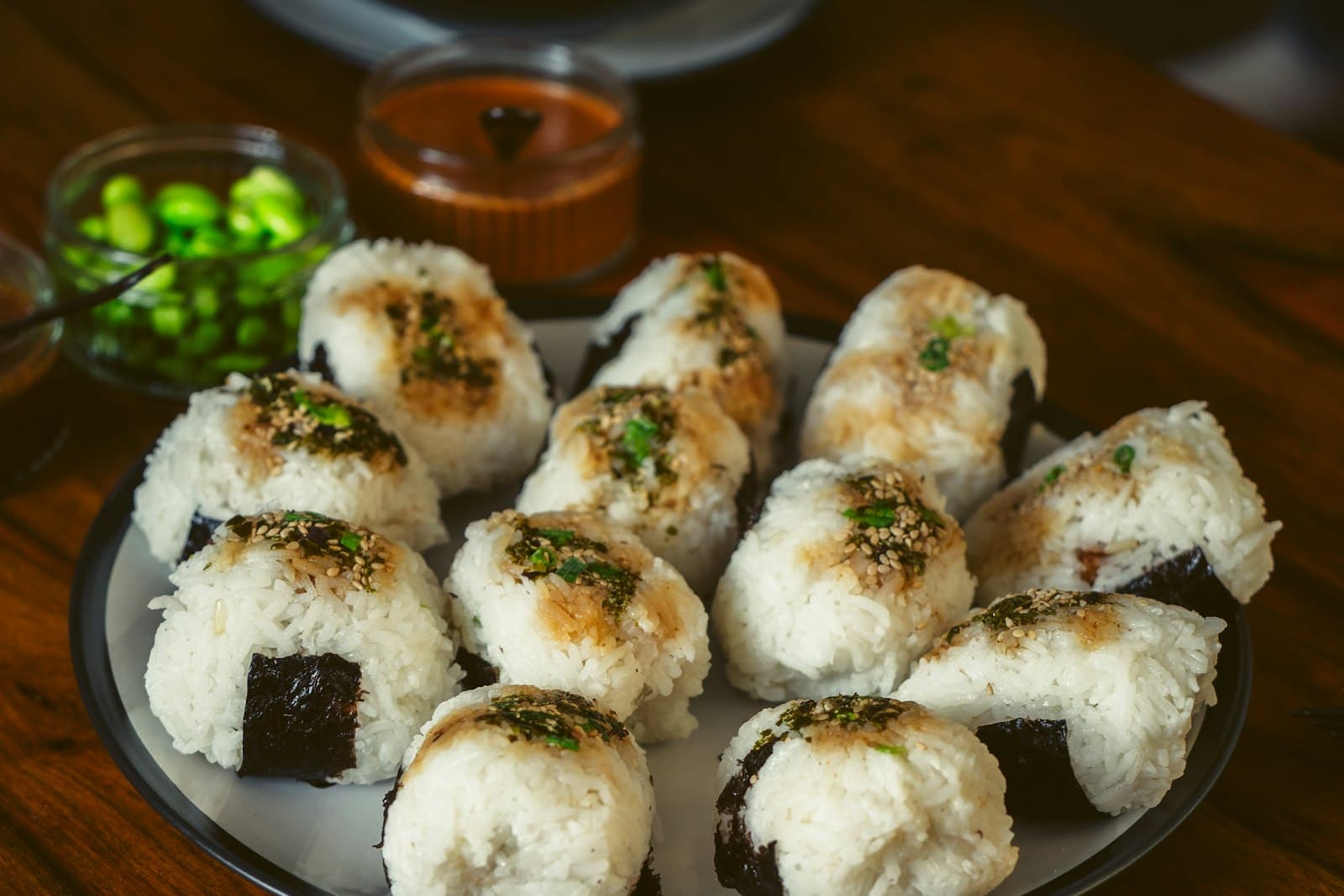
Onigiri are hand-shaped balls or triangles of lightly salted short-grain rice with a savoury filling in the middle, usually wrapped in a strip of nori. They are a classic Japanese lunchbox and convenience-store snack. This version uses flaked salted salmon, and the sticky rice does the rest: wet your hands, press gently and the rice holds together without any binder.
By Mei Lin Tan
Published
- Prep Time
- 20 mins
- Cook Time
- 25 mins
- Additional
- 10 mins
- Total Time
- 55 mins
- Servings
- 8 rice balls
How do you make Onigiri (Japanese Rice Balls)?
Cook 300 g short-grain rice with 420 ml water, then let it cool until you can handle it. Pan-fry 200 g salted salmon until it reaches 70°C (158°F) and flake it. With wet, lightly salted hands, press about 85 g of rice around a spoonful of salmon into a triangle. Makes 8 onigiri. Wrap in nori just before eating.
- Total time
- 55 mins
- Calories
- 390 per serving
- Protein
- 16 g
- Yield
- 8 rice balls
- Difficulty
- Easy
- Method
- Stovetop
Ingredients
Rice
Salmon filling
To shape
Equipment
Medium saucepan with a tight-fitting lid · Fine-mesh sieve · Small nonstick skillet · Instant-read thermometer · Small bowl of water for wetting your hands · Scissors or a sharp knife for the nori
Quick Directions
Cook the rice
Rinse the rice, then simmer covered for 13 minutes and rest for 10.
Cook the salmon
Salt and pan-fry the salmon to 70°C (158°F), then flake it.
Cool the rice
Spread the rice out and cool until warm to the touch.
Shape the onigiri
With wet salted hands, press rice around the salmon into triangles.
Wrap and serve
Wrap a strip of nori around the base of each onigiri just before eating so it stays crisp.
Step-by-Step Instructions
Follow these detailed steps to make the perfect onigiri (japanese rice balls).
Cook the rice
Rinse the rice in a sieve under cold running water, swirling it with your hand, until the water runs almost clear, about 1 minute. Put it in the saucepan with 420 ml cold water and bring to the boil over high heat. Cover tightly, turn the heat to its lowest setting and cook for 13 minutes without lifting the lid. Turn off the heat and leave the rice covered to steam for 10 minutes.
Cook the salmon
While the rice rests, pat the salmon dry and rub 1/2 tsp of the salt over the flesh. Heat the oil in the skillet over medium heat, add the salmon skin side down and cook for 4 minutes, then turn and cook for 3-4 minutes more, until it is opaque and reads 70°C (158°F) in the thickest part. Lift the fish onto a plate, pull off the skin and any bones, and flake the flesh into small pieces. Let it cool.
Cool the rice
Spread the rice in a shallow dish or on a large plate and fluff it gently with a spatula. Leave it for about 10 minutes, until warm rather than hot, so you can handle it comfortably. Aim to have the onigiri shaped and eaten or chilled within 1 hour of cooking.
Shape the onigiri
Wash your hands well first. Dissolve the remaining 1/2 tsp salt in the bowl of water. Wet your hands in it so the rice does not stick. Take about 85 g of rice (a heaped 1/2 cup), flatten it in your palm, press 1 heaped tbsp of salmon into the centre and fold the rice over to enclose it. Cup your hands and turn the rice while pressing lightly with the other hand to form a triangle. Press firmly enough to hold together but not so hard that the rice turns pasty. Repeat to make 8. Roll the tops in sesame seeds, if using.
Wrap and serve
Wrap a strip of nori around the base of each onigiri just before eating so it stays crisp. Serve at room temperature, or within the time limits in the storage notes.
Recipe Tips
- Use freshly cooked short-grain or sushi rice. Long-grain rice is not sticky enough and the balls fall apart.
- Shape the rice while it is still warm. Cold rice is stiffer and crumbles, but rice that is too hot burns your hands and goes pasty.
- You can also shape onigiri in a piece of plastic wrap: put the rice and filling in the centre, twist the wrap closed and squeeze into shape. It keeps your hands clean and is handy for wrapping for lunch.
- Packing onigiri for lunch: keep them in an insulated bag with an ice pack. Eat them within 1 hour of cooking if you can, and no later than 2 hours after cooking, if they stay at room temperature.
- Wrap the nori around each onigiri just before eating. If it is wrapped in advance it turns soft and chewy.
Variations
- Umeboshi (pickled plum): replace the salmon with a small piece of umeboshi, stone removed, about 1/2 per onigiri. Umeboshi is very salty and sour; if you cannot find it, use a pinch of salt and a few drops of rice vinegar, or a little pickled vegetable.
- Tuna mayo: mix 1 drained 120 g can of tuna with 1 1/2 tbsp Japanese mayonnaise (or regular mayonnaise with a pinch of sugar and a few drops of rice vinegar) and use in place of the salmon. These do not freeze well, because the filling turns watery, so eat them the same day.
- Furikake: stir 2 tbsp furikake (Japanese rice seasoning of seaweed and sesame) through the warm rice and shape with no filling, or put a little salmon inside as well. If you do not have furikake, use toasted sesame seeds and crumbled nori.
Nutrition (per serving)
| Calories | 390 |
|---|---|
| Protein | 16 g |
| Carbs | 60.5 g |
| Fat | 8.5 g |
| Saturated fat | 1.7 g |
| Fibre | 0.5 g |
| Sugar | 0.2 g |
| Sodium | 480 mg |
Estimated from the listed ingredients; values vary by brand.
Related Recipes
Storing & Reheating
- Fridge
- Cool quickly and refrigerate within 1 hour if you can, and no later than 2 hours after cooking. Eat within 2 days. Refrigerated rice hardens, so onigiri taste best eaten the same day.
- Freezer
- Wrap each onigiri individually in plastic wrap, without the nori, once cooled and within the same 1-2 hour window after cooking, not after a day in the fridge. Freeze for up to 1 month. Tuna mayo onigiri do not freeze well.
- Reheat
- Reheat from frozen in the microwave, still wrapped loosely, until steaming and hot to 74°C (165°F) throughout. Reheat once only. Add fresh nori after heating.
Onigiri (Japanese Rice Balls) FAQs
What is onigiri?
Onigiri are Japanese rice balls made from plain short-grain rice, lightly salted on the outside, usually shaped into a triangle or ball around a filling and often wrapped in nori. They are a popular lunchbox, picnic and snack food in Japan.
Why do my onigiri fall apart?
The rice is usually the wrong type, too dry or too cold. Use short-grain or sushi rice, shape it while it is warm and wet your hands with salted water so the rice holds together. Press firmly enough to bind the grains but not so hard that they turn mushy.
Can I make onigiri ahead of time for lunch?
Yes, but keep them cold. Eat or refrigerate cooked rice within 1 hour if you can, and no later than 2 hours after cooking, so pack them with an ice pack in an insulated bag. Add the nori just before eating. For longer storage, freeze them individually wrapped for up to 1 month.
What fillings can I use for onigiri?
Flaked salmon, tuna with Japanese mayonnaise, umeboshi, and furikake mixed into the rice are the most common. Any well-seasoned, fairly dry filling works. Cook any fish or meat filling fully first, to 70°C (158°F) for fish.
Disclaimer
- Nutrition information is an estimate based on the listed ingredients. It changes with the brands, portion sizes and swaps you use.
- Read ingredient labels for allergens and for diet claims such as gluten-free or vegan. Products and their ingredients can change.
- Cooking times are a guide, since ovens, air fryers and slow cookers all run differently. Use a food thermometer and cook meat, poultry and fish to the safe internal temperatures in government food safety guidance.
- This recipe is general information, not medical or nutrition advice. If you have an allergy, a health condition or a special diet, check with a qualified health professional.